MOI Full Form: What Medium of Instruction Means and How to Get the Certificate
Written by: Abhishek Chatterjee
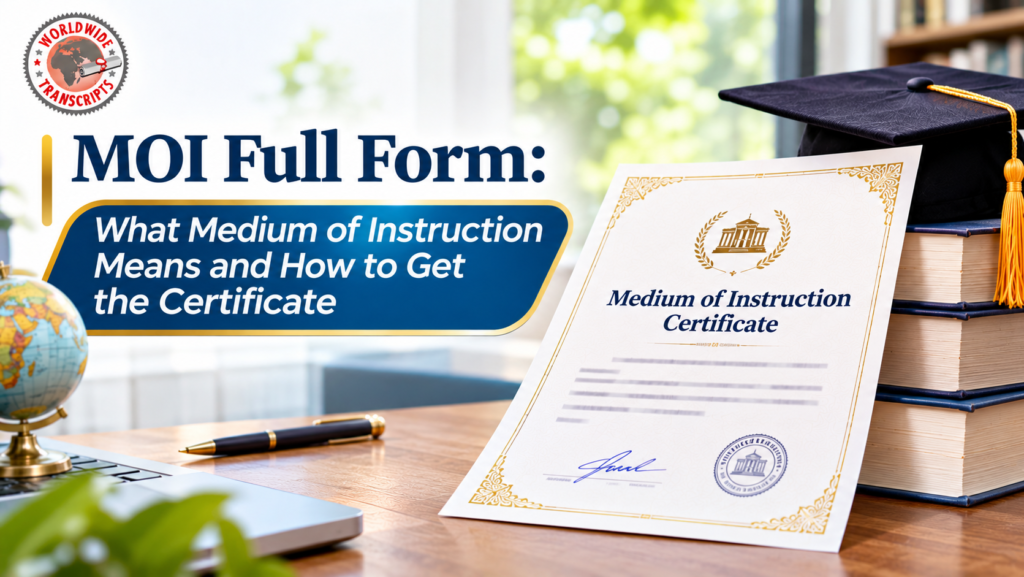
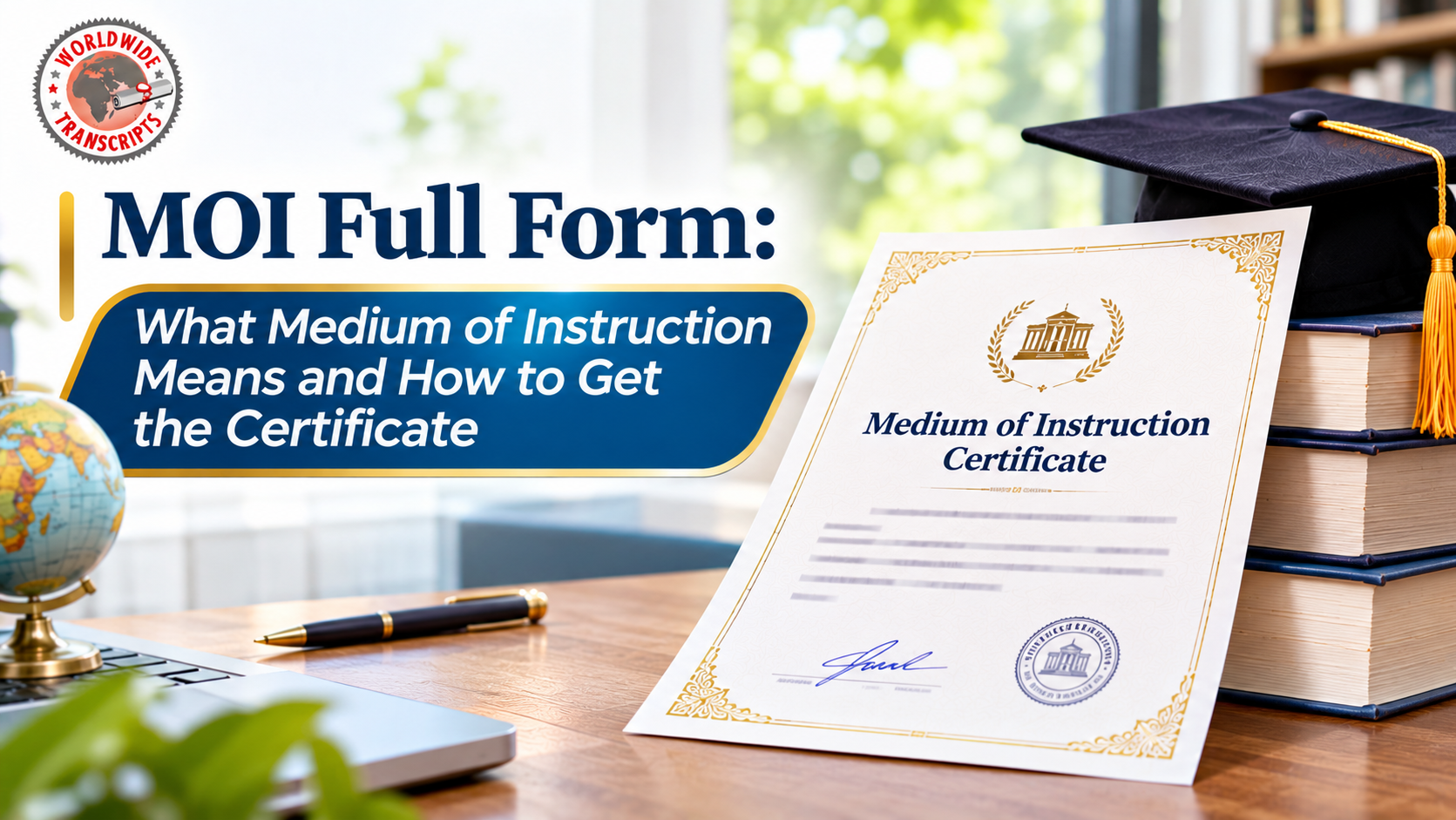
In education, MOI stands for Medium of Instruction, the language your course was taught and examined in. An MOI certificate is a letter from your university confirming that. Many universities abroad accept it in place of an English test, but each sets its own rules about who signs it and what it must say. We can request it and get it from your university for you.
In this guide:
- What MOI stands for
- What the certificate says and the signature
- How we get it from your Indian university
You’ve probably met MOI in an application checklist with no explanation: “submit your MOI certificate.” Short answer: it stands for medium of instruction. The longer answer matters more, because a certificate that’s worded slightly wrong or signed by the wrong person can be refused, and that usually shows up late in an application. This guide covers the meaning, what a good certificate says, what a few universities or institutions actually require, and how we get it. Worldwide Transcripts has delivered 175,000+ orders in 15+ years procured from across 850+ Indian universities. Requirements differ by receiver, so their checklist always comes first.
What MOI stands for
In education, MOI stands for medium of instruction: the language in which your programme was taught and assessed. For most Indian applicants, it’s English, which is why the certificate matters. A university abroad that would otherwise ask for an IELTS or TOEFL score may accept a letter from your institution instead. The letters MOI also appear in other fields (a memorandum of intent, for example), but in an immigration or overseas admissions context it’s almost always this.
What an MOI certificate says
It’s a letter on your university’s letterhead, usually signed by the Registrar or Controller of Examinations, confirming the language your programme was taught and examined in. It isn’t a self-declaration, and it isn’t an English test score.
The wording requirements vary. UNSW Bengaluru asks for an official statement from the Registrar confirming English as the sole language of instruction and assessment, on official letterhead and in original form. Universities or institutes abroad like Monash University Australia say the letter must be stamped by the Registrar’s office and state that the entire programme was conducted and examined in English. Illinois Tech Mumbai says the letter must come from the registrar or another authorised academic official and confirm that English was the language of instruction for the duration of the programme. Many international universities ask that documents of this kind come from the University Registrar or Controller of Examinations.
Some institutions issue one that covers the whole institution. IIT Kanpur’s, for example, certifies that English has been its medium of instruction since inception. Others issue one for your specific programme. Which one a receiver wants is worth checking.
Sources: UNSW Bengaluru, English language requirements; Monash University, English language requirements; Illinois Tech Mumbai, Graduate admissions; University at Albany, Graduate international applicants; IIT Kanpur, Medium of Instruction Certificate.
When a university abroad accepts it, and when it doesn’t
It’s accepted widely, but never automatically. The University of Tsukuba, for example, may waive English test requirements for applicants whose programme was taught in English, but it excludes distance education and says to attach an official letter from the university showing the official medium of instruction. Other universities accept it only for certain programmes, or only if you graduated within a set number of years.
Also remember what an MOI certificate isn’t. A credential evaluation doesn’t prove the language of your course either. IQAS, for instance, it assessments don’t list the language of instruction. If a programme asks for that proof, you need a separate MOI certificate. See Alberta.ca, IQAS assessment for immigration.
How we get your MOI certificate
You start online, and our team handles the university.
- Step 1: Find out what your receiver wants. The exact wording, the signatory, and whether it must be sent to them directly. Where: their admissions page or checklist.
- Step 2: Open the Worldwide Transcripts website. Go to worldwidetranscripts.com, or message us on WhatsApp at +91 88173 53627 which only takes a minute
- Step 3: Fill in the enquiry form. Share your university, programme, year of passing, the wording your receiver asked for, and where the certificate is going. It will only take a few minutes of your time.
- Step 4: We check your records and send a quote. You see the amount before you pay, then pay online through our site or the Pay Online page. Time depends on your case.
- Step 5: We deal with your university. We raise the request with the Registrar or Controller of Examinations, share your receiver’s wording, and follow it up. You follow the progress on the app. Timeline of procurement depends on the university and your records.
- Step 6: Delivery. The certificate goes to your doorstep, or to the recipient. If they accept electronic copies, ask about our e-transcript service.
Rather not chase the university yourself? See our medium of instruction certificate service or talk to our team.
Documents to have ready
Your degree or provisional certificate, your marksheets including backlogs, your registration number, programme, college and year of passing, and a government ID or passport with a name that matches your records. Add your receiver’s checklist or the exact wording they’ve asked for, because that’s what decides whether the letter is accepted. We’ll confirm the exact list when you enquire.
How long it takes
Timeline totally depends on the issuing university or the institute. Some registrars issue a letter quickly, and others need a formal request, a standard format, or approval from more than one office. Complete records and a clear request move fastest. Ask us about your case when you enquire.
Do it yourself or go through us
Plenty of people ask their university directly, and for some it’s easy. It gets harder when the receiver wants specific wording, an original on letterhead, a stamp from the Registrar’s office, or delivery straight to the university abroad. You may have to explain the requirement, follow up repeatedly, and find out afterwards that the letter says something slightly different from what was required.
With us, you send your details once, pay online, and follow progress on the app. We share your receiver’s wording with the university, follow up, and send the certificate where it needs to go. We also check your records before anything goes in, so the usual slips get caught early. If that sounds easier, start your request or talk to our team.
Where people slip up
The most common mistake is getting a letter that doesn’t say what the receiver needs. A general line like “the medium of instruction is English” may not satisfy one who wants the whole programme named. Another is the wrong signatory: some universities specify the Registrar or Controller of Examinations, and others won’t accept a department letter.
People also forget the stamp or the original copy, apply after a deadline, or assume an MOI letter replaces a transcript. It doesn’t. And if you studied by distance education, check whether the receiver accepts it at all.
What we see
The confusing part of MOI isn’t the document; it’s the variety of requirements. Two universities can ask for the same thing in slightly different words, and the university that issues the letter doesn’t know which one you need. We bridge that before anything goes out. We work with 18+ affiliated ECA bodies, for example, NCEES, GCE, IERF, Ed Perspectives, CES and IQAS. See our affiliates.
A quick check before you start
- Do I know the exact wording my receiver wants?
- Do I know who has to sign it, and whether it needs a stamp?
- Does it need to come from the university directly, or can I send it?
- Do I know whether distance education is excluded?
- Does my name match across documents and passport?
- Do I know whether an apostille or attestation is needed?
Author

Why Choose Worldwide Transcripts?
Conclusion
MOI is a short phrase with a long list of conditions. Find out exactly what your receiver wants, who they want it signed by, and how they want it delivered, then request it from your university early. After that, it’s the university’s side, which is the part we take off your hands. If you’d rather not manage it, send us your details and follow progress on the app.
Start Your MOI Certificate Request: enquiry form · Enquiry form → Personalised quote → Pay online → Live updates on the app → Delivered.
Sources:
- UNSW Bengaluru, English language requirements
- Monash University, English language requirements
- Illinois Tech Mumbai, Graduate admissions and degree requirements
- University at Albany, Information for graduate international applicants
- University of Tsukuba, How to submit English test score
- IIT Kanpur, Medium of Instruction Certificate
- Alberta.ca, IQAS assessment for immigration
Related posts: WES Reference Number: What It Is & Where to Find It · IQAS or WES: Document Requirements · How to Apply for a University Transcript Online (2026) · MEA Apostille in India
Related universities: University of Lucknow · Guru Nanak Dev University · University of Mysore · All universities