
Uncategorized

global immigration trends
Uncategorized

How Global Events Are Reshaping Immigration for Skilled Professionals

The global job market is changing fast. Newer technology is being developed and industries are adapting to economic uncertainty; citizens are ageing, and nations are competing among themself to get candidate with the right skill sets and experience. All of this is changing immigration too. For skilled professionals, immigration now is not only about finding a good job for moving to a new country. Governments are nowadays using specific immigration programs to fill in the real workforce or labour market demands. Healthcare, engineering, technology, education, construction, transport and other important infrastructure sectors are getting more preference as countries try to fill skill gaps, and at the same time, applicants are facing more stricter document-focused immigration process. So now having the right qualification is important, but being able to verify that education and validate your credentials is just more important. What Is Changing the Global Immigration Landscape? The ongoing major global circumstances are affecting where skilled professionals are needed and how countries are selecting them. Technology is one of the biggest factors, and as per the World Economic Forum’s Future of Jobs Report 2025 found that AI and big data, networks and cybersecurity, and technological literacy are among the fastest-growing skills. It also projects millions of new jobs and millions of displaced jobs by 2030, resulting in a net increase of 78 million jobs. The demography also play a major role in the same. Multiple developing countries have ageing populations and fewer people in the working age group entering the labour market. Healthcare, elderly care, education and people-focused services therefore continue to require global talent. Then there is the green transition. Renewable energy, sustainable infrastructure and environmental projects are creating new demand for engineers, technicians, project specialists and other professionals. These changes are not happening separately. They are affecting immigration policies at the same time. Countries Are Becoming More Targeted About Skilled Immigration Canada is a good example. For 2026, Canada’s Express Entry system has continued category-based selection for healthcare and social services, STEM, trades, education and French-language proficiency. New categories also include physicians with Canadian work experience, researchers, senior managers, transport occupations and certain skilled military recruits. The message is fairly clear: Canada wants immigration to respond to specific economic and labour-market requirements. Germany is following a somewhat different model. Its Opportunity Card allows eligible non-EU/EFTA professionals to enter Germany to look for employment. Applicants can qualify through a recognised qualification or a points-based route, subject to the relevant requirements. The 2026 financial requirement is at least €1,091 net per month. For Indian professionals, this can create another route to explore when their qualifications and experience match the German labour market. Australia and Other Destinations Are Doing the Same Australia’s skilled migration system also places strong emphasis on occupations and employer demand. Employer-sponsored routes, skilled visas and state or territory nomination programs continue to form an important part of the country’s workforce strategy. The wider trend is worth noticing. Countries are competing for skilled workers, but they are becoming more selective about which skills they need and how applicants demonstrate them. That means professionals should not look at immigration as simply a visa application. It is better to think of it as a complete profile. Your occupation, education, work experience, language ability, skills assessment and supporting documents all need to tell the same story. Why Academic Documents Matter More Than Ever This is where many applicants underestimate the process. A professional may have years of experience and a recognised degree. But when an immigration authority, employer, university or credential assessment body asks for an academic transcript, the applicant still needs to provide the required evidence. An academic transcript is more than a list of marks. It is important proof of education. It helps academic institutions, employers and assessment bodies understand what you studied, where you studied and what qualification you completed. Depending on the destination and application, you may need an official transcript, degree certificate, verification of credentials or other supporting academic records. This is particularly important for Indians applying internationally because procedures vary from one Indian university to another. Some universities offer an electronic transcript directly. Others may still follow physical or university-specific processes. In either case, applicants should check what the receiving institution or immigration-related authority actually requires. An electronic transcript should not simply mean a scanned copy of a marksheet. Where accepted, it should be an official academic record transmitted through an appropriate and verifiable channel. Don’t Wait Until You Need to Request a Transcript One common mistake is waiting until an application deadline is close before trying to apply for transcript. A university transcript can take time to obtain. There may be an application process, document checks, fees, university approvals and dispatch requirements. If your university does not provide an electronic transcript, you may need to follow its physical transcript process. If it does provide one, you still need to make sure the electronic transcript meets the receiving organisation’s requirements. This is where professional transcript services can make the process easier. A reliable transcript service provider or transcript agency can help applicants understand the university process, request transcript, coordinate with the institution and arrange the required delivery or transmission. The important point is not simply speed. The document needs to be official, verified and authoritative. Where Worldwide Transcripts Fits In Worldwide Transcripts Pvt Ltd helps students and professionals obtain academic documents from Indian universities for international education, employment, credential evaluation and immigration purposes. Its transcript service covers official university transcript procurement, electronic transcript support, academic document verification, MOI certificates, document attestation and secure document delivery. For applicants who need to request transcript from an Indian university, the service can be especially useful when university procedures are difficult to manage from outside India. Worldwide Transcripts works with documents from 850+ Indian universities and has more than 15 years of experience in academic document procurement. The New Immigration Reality for Skilled Professionals Global events will continue to change the skills countries need. AI may create new occupations.

Canada PR
Uncategorized

How to Improve Your Chances of Getting an ITA With a Lower CRS Score

A practical guide for Indian applicants looking at Canada PR, while keeping the UK, USA & Europe in view Getting an Invitation to Apply (ITA) for Canada permanent residence can feel difficult when your CRS score is below the score you keep seeing in Express Entry discussions. But a lower CRS score does not automatically mean that your Canada PR plan is over. The important thing is to understand how Express Entry works today and where your profile may fit. Canada does not use only one type of draw. IRCC may conduct general, program-specific or category-based intake rounds, and the eligibility norms may keep on changing from time to time. So asking this question, “How can I make my profile stronger and identify the immigration pathway that actually matches my skills?” is somewhat better than asking “How can I somehow get more points?”. That small change in strategy can make big difference later.   First, Understand What Your CRS Score Actually Means The Comprehensive Ranking System (CRS) is used to rank eligible candidates in the Canadian Express Entry pool managed by the IRCC. Your score generally include factors such as age, education, language proficiency (English & French), Canadian work experience, foreign work experience, spouse or partner factors, and additional points if any from a specific PNP. A provincial or territorial nomination can add 600 CRS points. This is important because there isn’t one universal CRS number that guarantees an ITA. IRCC decides the type and size of each invitation round, and category-based rounds can target candidates who meet specific economic priorities.  That gives lower-scoring candidates another area to explore.   1. Look Beyond the General Express Entry Draw If your CRS is not competitive or looks low for a general draw, you can check if your profile and skills qualify for a category-based selection. Canada’s current categories include the following: French-language proficiency Healthcare and social services STEM Skilled trades Education Transport Physicians with Canadian work experience Certain other Canadian-experience categories Category-based selection is designed to meet specific economic needs. Candidates still need to meet the laid-out Express Entry prerequisites. For an Indian applicant, this means your occupation and language proficiency profile can matter just as much as the headline CRS number.   2. Don’t Undervalue The Language Score Language ability is one of the areas where candidates can actively improve their profile. For English, a higher Canadian Language Benchmark (CLB) can increase your CRS. The difference between CLB levels can also affect your skill-transferability points. French can provide another route. Candidates who achieve the required French-language results may qualify for Canada’s French-language category. IRCC currently requires a minimum NCLC 7 in all four French-language abilities for this category, subject to the requirements of the particular invitation round. For someone sitting at a lower CRS score, improving language results may therefore be more useful than simply waiting for a draw.   3. Check Whether Your Education Is Evaluated Correctly Your educational background can affect both your eligibility and your CRS. For applicants who are educated in India, an Educational Credential Assessment (ECA) is generally important when using foreign education for Express Entry points. IRCC uses the ECA assessment or evaluation reports to determine the Canadian equivalency of your foreign credential. Here, transcripts and academic documentation become important. Your degree certificate display the completion of your course, but the transcript or official statement of records provides the detailed academic record serving as proof of education to validate your academics for admissions and immigration requirements. If your university transcript is not available, or cannot be verified through the official university channel, your immigration process can become complicated.   4. Consider a Provincial Nominee Program A lower CRS score can also make it worth exploring Canada’s Provincial Nominee Programs (PNPs). Canadian provinces and regions have their specific immigration streams, which is designed as per the regional workforce needs. If you get an invite to Express Entry-linked provincial nomination, IRCC straightaway awards 600 bonus CRS points, which further helps in making your profile stronger. That is a substantial change to your profile. However, a nomination is not simply as each province has its own norms, requirements and eligibility criteria, the streams can open, close or change according to the current labour-market demands. So try and opt on getting as much information you can related to PNP, Express Entry and Provincial Demands at the moment.   5. Build Appropriate Work Experience Work experience can strengthen your personal profile, particularly when it aligns with  occupation and the requirements of the immigration program or the intake stream or category you are targeting. IRCC suggests improving language proficiency, education, skilled work experience and analysing provincial nomination possibilities while remaining in the Express Entry pool. For Indian candidates, this implies documenting your skill-sets and work experience properly. Job titles alone is not enough. Your still sets, employment dates, working hours and its supporting documents should be available and in sync. A stronger profile is about having relevant and properly documented work or job experience.   6. Don’t Make Canada Your Only Immigration Plan This is an important point for applicants with a lower CRS score. Canada is not the only country looking for international talent. You can aso look for other countries or options like the UK Skilled Worker route allows eligible professionals to work for an approved UK employer in an eligible occupation, which is subject to sponsorship and other laid-down requirements. The US has employment-based immigration pathways which cover categories such as EB-2 and EB-3, with stipulated eligibility and visa availability depending on the specific category and possibilities. In the Europe, the EU Blue Card has a route for highly qualified foreign professionals who meet the required education or skillsets, job and salary prerequisites. The scheme applies in multiple EU nations.  So if Canada is not immediately accessible, your qualifications may still open doors elsewhere. The key is to compare the requirements rather than treating every country as if it follows the same points system.   7.

French language Express Entry advantage for Canada PR
Uncategorized

French Language Advantage: The Immigration Opportunity Many Indians Overlook in 2026

When most Indians begin considering how to get Canadian PR, there is a common understanding that only hard work and a higher score in the Express Entry system can guarantee success. The main way to increase CRS points is through higher studies, work experience, and language test results like IELTS or CELPIP. But there is a simple trick which can give significant results. This trick is to learn French. It doesn’t matter if a person is from a French-speaking country. In fact, nowadays Indians who are native English speakers are also learning French to improve their chances of getting Canadian permanent residency. Learning French gives a massive advantage to people applying for Express Entry immigration to Canada, especially those who want to immigrate to provinces outside Quebec. In 2026, this advantage is particularly attractive to those Indians who are thinking about moving to Canada as it will benefit them immensely.   Why is learning French such a great idea? Canada has two official languages, English and French, but outside Quebec, very few people speak French. To combat this issue, the Government of Canada is trying to encourage immigration to provinces, other than Quebec, with French-speaking immigrants. It has been found that many Indians and non-native English speakers are learning French which helps them greatly during the Express Entry application process. Here’s why: The French-Speaking Target: The Canadian government has targeted a certain percentage of French-speaking permanent residents in its 2026 Immigration Levels Plan. The number is set to increase from 8 percent in 2025 to 9 percent in 2026, rising further to 9.5 percent in 2027 and 10.5 percent in 2028 before hitting 12 percent in 2029.   French Has Become One of the Strongest Express Entry Advantages Canada’s Express Entry system has seen significant changes in recent years. Instead of the usual drawings, Immigration, Refugees and Citizenship Canada (IRCC) is drawing from categories that specify particular criteria required for immigration candidates. One of these sought-after skills is proficiency in the French language. The upside of this trend is that candidates with the required language skills typically receive invitations with much lower Comprehensive Ranking System (CRS) scores than those without. For instance, in July 2026, IRCC conducted a French language category draw and issued 5,000 Invitations to Apply (ITAs) with a CRS score of 399. Another French category draw of 5,000 ITAs was held earlier this month, with a score of 420. For many aspiring immigrants, the combination of these two elements can determine their future in Canada.   Why Does Canada Need More French-Speaking Immigrants? Canada’s labor market has a demand for skilled workers in various industries. However, the government is interested in attracting specialists who can fill vacant positions while contributing to the economic growth of French-speaking regions outside Quebec. The demand is particularly high in Healthcare, Education, Information Technology, Engineering, Skilled Trades, Public Services, Finance. At the same time, Canada aims to promote economic growth in these areas by meeting the demand for bilingual specialists for the long-term. It is not just another immigration program; it is a strategy that involves provinces and official languages. Thus, Canada’s new immigration program benefits from offering opportunities to those skilled in French.   New Opportunities Beyond Express Entry The new initiatives start functioning immediately and aim to contribute to attracting Francophone immigration to Canada in several ways. Firstly, there is an offer to provide 5,000 additional federal selection places for the provinces and territories to nominate French-speaking immigrants. This includes the allocation of PNP (Provincial Nominee Program) places. Consequently, it is expected that the number of PNP nominees who are proficient in the French language will increase. This change should be especially beneficial to the immigrants from India, as it provides them with more opportunities to apply for permanent residency in Canada. Secondly, the pilot program for students from French-speaking minority communities was prolonged till 2027. As a result, there is a possibility for students from outside Quebec to receive permanent residency, if they participate in the FMCSP (French Minority Communities Settlement Program).   Why Indians Love This Idea of Learning French India produces some of the best minds in the country. There are thousands of Indians applying for immigration to Canada every year. From engineering graduates, nurses, IT professionals, teachers, accountants, and healthcare workers; Indians have proved to be one of the most eligible communities for Canadian immigration. However, the competition is hard, and Indians must strive to be better than others. For instance, by learning the French language, Indians can increase their chances of fulfilling the French language proficiency requirements. Regardless of your profession, the immigration department will ask for your academic credentials to assess your eligibility in Canada. Therefore, even though language skills are important for your PNP application, your academic qualification holds much more significance in the eyes of the Canadian authorities.   French Doesn’t Replace Your Qualifications Although learning the language is helpful, immigration authorities require proof of education. Your documents are still essential, and their importance will not be diminished by your language skills. Depending on the type of claim you make, you need to submit Official University transcripts, Degrees, An ECA (Educational Credential Assessment), Electronic transcripts, Medium of instruction certificates, University verification documents, Therefore, getting them ready in advance will save you time and hassle if you get invited.   Why Transcript Preparation Should Start Early Many applicants spend the time before the orders of their academic documents by the universities before responding to their Invitation to Apply. However, universities may not necessarily respond to your request for transcripts promptly. Some require approvals, verification, payment, or mailing of physical transcripts before releasing them. It is therefore essential that you have your transcripts in order if you intend to change your immigration status. By doing so, you stand a better chance to take advantage of any opportunities that may arise.  

Process for JNTUK transcript
Uncategorized

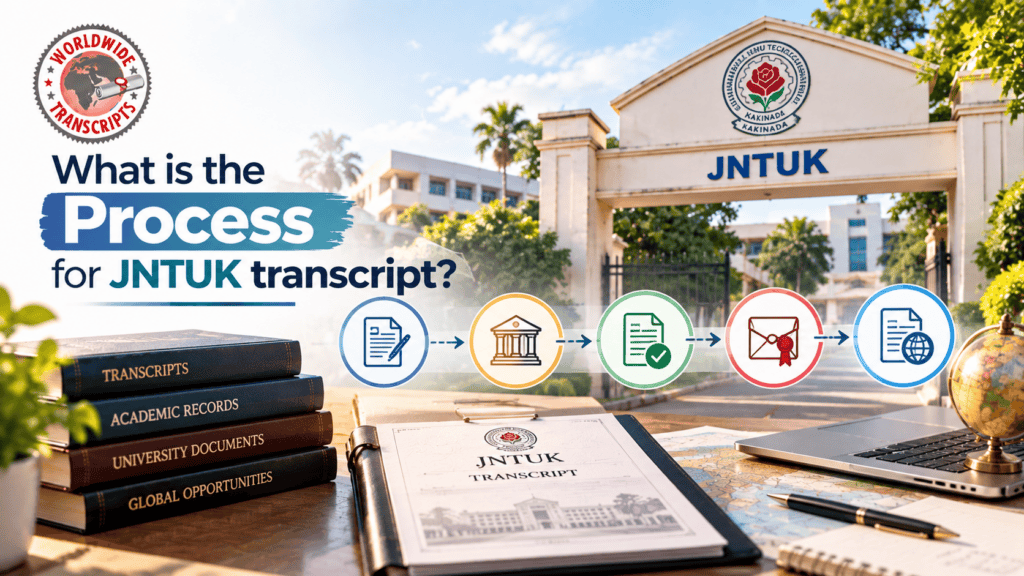
What is the Process for JNTUK transcript?

Dealing with the paperwork at a university can be really confusing, especially when you need it to plan your future. For people who graduated from Jawaharlal Nehru Technological University, Kakinada, going for work or higher education means they have to know how the university handles paperwork. If you want to go to a college abroad for higher education or move to another country, you have to get your JNTUK transcript. This document is like an academic report card that shows everything you did in the courses you took and the grades you obtained each semester. It is an idea to know how the university handles the procurement of these academic documents so when you apply to a university abroad for higher education, licensing or jobs in other countries everything goes smoothly and you do not have any problems with your JNTUK transcript.   The Role of an Official Transcript in Global Admissions  An official transcript is more than a collection of your marks. It is a document that the university registrar puts together checks and seals. For people who graduated from Jawaharlal Nehru Technological University this document helps explain your academic record, serving as proof of education to universities and employers in other countries. They need a document that shows your complete academic record clearly. Your official transcript is very important if you want to study or get a US Visa in 2026. It shows how well you did in your studies. Helps the people evaluating your application understand your academic abilities.   Critical Factors in the University Verification Pipeline  Getting your official records from the Kakinada campus involves a lot of steps. The university has to check your history to make sure it is real.  They need to check every single semester marks memo, your provisional certificate and your original degree to make sure they match the university’s records. If there is any mistake the process stops. The university also has to put the documents in an envelope, seal it and sign it with the registrar’s signature. If the envelope is not sealed or is broken it will not be accepted. Some universities and employers want the documents to be sent directly to them. This way they can be sure that the documents have not been tampered.   Why Managing the System Independently is Risky  You can try to get your documents on your own but it can be difficult. You have to deal with payment systems, university holidays and mistakes on your marks memos. You also have to track your documents when they are being sent. If you have a job or are studying for exams, it can be very stressful to manage the university process. Unlike some universities, Jawaharlal Nehru Technological University transcript process may feel complicated. If you make a mistake or do not have all the documents, your application can be delayed. This can cause you to miss deadlines. For example, the process is different from the Anna University transcript process. You have to be very careful and make sure you have all the documents. If you do not, your application can be delayed for months. This can be a problem if you are trying to get into college or get a visa.   Streamlining Your Documentation with Expert Help  Your global goals depend on getting everything right and on time. So it’s not a good idea to take chances with your academic documents. Dealing with university administrations can be really tricky. You need experts to help your paperwork move quickly through the verification process. Trying to keep up with university updates or stressing about shipping getting expert help is the best option. When you choose a transcript service you get a team of experts who work directly with the university for you. They handle collecting, verifying, sealing and sending your transcripts internationally. Letting experts handle the paperwork means you can focus on your career goals knowing your important documents are in hands. They know how to get transcripts from JNTU Kakinada.

Global Immigration for Skilled Professionals in Canada UK USA and Europe
Uncategorized

The Green List Evolution: What It Means for Professionals Planning Global Immigration

The term “Green List” has become familiar to people planning skilled migration. In its original immigration context, it refers specifically to New Zealand’s list of in-demand occupations. But the idea behind it has spread much further. Today, Canada has category-based Express Entry selection. The UK uses occupation and shortage-based immigration rules. Germany has shortage occupations under the EU Blue Card framework. The European Union is building an EU-wide Talent Pool. The US continues to operate employment-based immigration categories for skilled workers and professionals. The names are different. The idea is similar: countries want international professionals who can fill genuine workforce needs. For an Indian professional considering Canada, the USA, UK or Europe, this shift is important. Your occupation matters. Your experience matters. And increasingly, your ability to prove your qualifications with proper academic documents matters too.   What Is Actually Changing? A Green List is not simply a list of “good jobs.” It is a way of identifying occupations that a country needs. New Zealand provides the clearest example. Its Green List has two tiers. Tier 1 roles can lead to the Straight to Residence Visa, while Tier 2 roles can lead to Work to Residence after the required period of New Zealand work experience. Applicants must also meet requirements around qualifications, registration and pay. But other countries are taking their own approach. This is where the bigger global trend becomes interesting. Canada: From General Immigration to Targeted Skills Canada’s Express Entry system has become increasingly targeted toward specific labour needs. For 2026, Canada continued categories covering areas such as healthcare and social services, trades, STEM and French-language ability. It also introduced categories for researchers, senior managers with Canadian work experience, and transport occupations. This matters to Indian professionals because it changes how immigration planning should be approached. Instead of asking only, “Can I qualify for Express Entry?”, applicants need to look at the bigger picture: Does my occupation, education and experience match Canada’s current priorities? Provincial Nominee Programs remain another important route, with provinces and territories able to align nominations with regional labour needs. UK: The List Is Becoming More Selective The UK has also moved toward a more controlled, occupation-focused system. The Skilled Worker route uses occupation codes and skill levels to determine eligibility. The UK’s Immigration Salary List provides reduced salary and skill requirements for selected occupations, while the government has also been developing a Temporary Shortage List for certain mid-skilled occupations considered important to the economy and critical infrastructure. The latest numbers show just how much the UK immigration environment has changed. In the year ending June 2026, 120,105 Worker visas were issued, including Skilled Worker and Health and Care Worker visas. That was 30% lower than the previous year. So the message for professionals is fairly simple: having a job title that sounds skilled does not automatically make you eligible. The occupation code, salary, sponsor and current immigration rules all matter. USA: Skilled Immigration Still Has a Strong Employment Focus The United States does not have a single “Green List.” Instead, employment-based immigration is divided into categories such as EB-1, EB-2 and EB-3. EB-2 covers professionals with advanced degrees or people with exceptional ability, while EB-3 includes skilled workers and professionals. For Indian applicants, however, availability can be a major consideration. The September 2026 Visa Bulletin shows separate employment-based cut-off dates for India. In May 2026, the US Department of State also announced that the annual EB-2 allocation for India had already been reached for FY2026, with visa issuance expected to resume after the new fiscal year began on October 1, 2026. This is an important reminder that eligibility and visa availability are two different things. A professional may qualify for an employment-based category but still face a waiting period because of annual limits and country-specific demand. Europe Is Building Its Own Talent Network Europe is also responding to the same problem: an ageing workforce and shortages in several professional sectors. The EU Blue Card provides a route for highly qualified non-EU workers who have the required qualifications or professional skills and an eligible job offer. It applies in 25 of the 27 EU Member States, with Denmark and Ireland outside the scheme. Germany is a particularly useful example. For 2026, Germany’s shortage occupations under the EU Blue Card include areas such as: STEM professions IT Engineering Healthcare Nursing and midwifery Teaching Architecture Transport planning Construction and related management roles For certain shortage occupations, the 2026 salary threshold for an EU Blue Card is €45,934.20, compared with €50,700 for other qualifying occupations. Germany’s Opportunity Card also gives eligible international professionals another way to enter the country and look for employment. And the European picture is getting broader. In June 2026, the EU formally launched the EU Talent Pool framework, designed to connect non-EU jobseekers with employers facing labour shortages. The platform is being developed for full operation in the future. For Indian professionals, this could make European job markets easier to explore, although participation and immigration decisions remain subject to individual country rules.   What Does This Mean for Indian Professionals? The biggest change is that immigration is becoming more closely connected to real labour-market demand. That means your planning should start with your occupation. Then look at: Occupation→Qualification→Work Experience→Skills Assessment/Recognition→ Immigration Pathway → Documentation The last part is often overlooked. A professional may have ten years of experience, but immigration authorities still need evidence of the education behind that career. This is where official university transcripts become important.   Why Transcripts Matter More Than You Think A degree certificate tells an authority that you completed a qualification. A transcript provides the academic record behind that qualification. Depending on the destination and assessment body, applicants may need: Official university transcripts Degree certificates Electronic transcripts Academic verification Medium of Instruction (MOI) certificates Qualification assessments Professional registration documents For Indian applicants, obtaining these records can sometimes be complicated. Universities have different procedures, processing times and document requirements. That is why transcript procurement should not be treated

Transcript Evaluation Time in 2026 for Canada UK and US
Uncategorized

How Long Does Transcript Evaluation Really Take in 2026 (Canada, UK, US Compared)

Navigating academic documentation means having a clear idea of how educational qualifications from other countries are assessed in different countries. For people who have graduated and are working in their fields. Having moved to another country, getting an official Educational Credential Assessment (ECA) is a key step. Whether someone is looking for residency, a chance to study more, or to get a professional licensing, knowing how long it takes to evaluate their university records is important for planning. Since the time it takes can be very different depending on where they’re going and which agency is handling the request, being aware of what to expect helps people avoid big delays.   Understanding International Credential Recognition and Evaluation  International recognition is the official process where a government group, a university, or an approved agency checks the value of a foreign education degree compared to local standards. This process is not about translating Documents; it includes looking at the courses taken, the way grades are given,n the university’s approval status,s and how long the program lasted. For people coming from other countries, the evaluation report is like a clear link between their academic background and the new academic or employment opportunities they want. Without this assessment, ECA’s and universities can’t really tell how good or strong someone’s education was. Using Worldwide Transcripts services helps make sure that the first steps, with document or transcripts procurement, are handled quickly so there are no problems when the file gets to the evaluation agency.   Canada Transcript Evaluation Timelines (WES, IQAS, CES, ICAS)  Canada continues to be one of the places for people looking to move to another country for work, PR or for higher education. This means that ECA bodies like World Education Services, the International Qualifications Assessment Service, and the Comparative Education Service are well known to people who need their education credentials checked. The time it takes to get an evaluation can change. It depends on how busy the ECA bodies are and how complicated the documents are. World Education Services Canada: This service usually finishes the evaluation within 7 to 10 business days after they have all the required university records and other Documents submitted. These Documents need to be checked in detail to get to know the academic background of the person. International Qualifications Assessment Service: This service works in Alberta. The time it takes depends on the number of applicants for express entry as well as for provincial nomination program. This depends on how many people have already applied and how much time it takes to evaluate the university programs. Comparative Education Service: This service is run by the University of Toronto. The time it takes is usually normal but it too depends on the number of applications submitted and the course and purpose. Sometimes evaluation in other countries can make the whole process take longer. International Credential Assessment Service: The time it takes here changes depending on how many documents of unique applicants are in system to be evaluated. It can take some time to evaluate the university records that are put into their system. People who want to move to Canada through programs like Express Entry often use WES services to make sure their education records fit the rules.   United States Evaluation Speed and National Association of Credential Evaluation Services Standards  The United States has a system where each university makes its own rules. This means that the way education records are checked depends on the group that does the check. Groups like the National Association of Credential Evaluation Services include many of the renowned ECA bodies of the United States like NCEES, Josef Silny & Associates, World Education Services and many more. In the United States, the way evaluations are done is different from Canada. In Canada, some ECA’s handle immigration-related checks. In the United States, there are different choices, and the time it takes can vary. Standard Processing: Most of the groups that’re part of NACES finish the evaluation within 7 to 14 business days once the official university records arrive. Urgent Services: Many of the US evaluation groups offer options. These can take from 24 hours to 5 business days. They cost more money. Institutional Variances: Even if the evaluation body finishes the work, US universities or the people who give licenses often check the records again. This can add weeks or even months to the process.   United Kingdom Comparability and UK ENIC Timelines  In the United Kingdom, the people who figure out if international qualifications are okay to use are the ones at UK ENIC, which earlier used to be called UK NARIC. The ECA’s in the United Kingdom provide you with a statement known as an assessment report that says what your qualifications are similar to, going through every single course you undertook. The time it takes to get this done is usually between 10 and 15 working days and may take longer depending on the actual load on the body for the service that UK ENIC offers. They also have options, like a 24-hour service and a 5-day service, for people who need their qualifications recognised really quickly because they have a job or higher education to start. If you are going to work in fields like healthcare, law or academic teaching the evaluation body that oversees those fields will have to look at your qualifications, and that can make the whole process take a lot longer than it normally would with just UK ENIC. Comparative Overview of Evaluation Ecosystems Destination Country Major Assessment Bodies Standard Processing Window Expedited Options Available? Common  Bottleneck Canada WES, IQAS, CES, ICAS 2 weeks to 25 weeks Limited / Varies by agency University dispatch delays & verification backlogs United States NACES Members (ECE, WES, etc.) 1 to 3 weeks Yes (24 hours to 5 days) Institutional matching & course breakdown requirements United Kingdom UK ENIC 10 to 15 working days Yes (24-hour & 5-day tiers) Additional professional statutory body reviews Key Factors

WES vs UK ENIC vs NASBA credential evaluation comparison
Uncategorized

WES vs UK ENIC vs NASBA: Which Evaluation Body Do You Actually Need

People who want to work or study abroad often face a lot of documentation hurdles in getting their academic credentials procured, and evaluated. When you move to a country, you need to get your degrees and transcripts from Indian universities, making sure they meet the academic standards of that country. The agency you choose depends on where you’re going and what you want to do. You need to know the difference between WES, UK ENIC, and NASBA so your academic credentials meet other countries’ requirements.  Understanding International Credential Evaluation  When you want to work or study abroad, you need to get your academic credentials evaluated. This is like a bridge between the university system in your country and the work or university system in another country. Universities and employers in other countries do not know what the grades or credits from your university mean. So special agencies look at your credentials, known as ECa bodies, commonly known as evaluation bodies, who make them easy to interpret. These agencies figure out if your degree is equal to one from the country you are moving to. They look at the courses you undertook, grades obtained and credit points, along with whether your university is accredited or not. They then generate a report known as an evaluation report that shows your course equivalence to the country you are migrating to. This report is like a detailed comparison of your record. It makes sure that your records are real and equivalent to a specific course in the destination country. To get the evaluation report, you need to have the right documents from your university. If you want to know more about how to get your records ready for use in another country, you can look at our Transcript Services. Core Differences Between Major Evaluation Bodies Each major evaluation bodies works in an area and helps specific types of professionals or students. Choosing the group saves time and makes sure your application follows the exact rules of the country you are applying to.  Evaluation Body Primary Jurisdiction Primary Target Audience Core Focus Area WES (World Education Services) North America (USA and Canada) Immigrants, university applicants, and professionals General immigration, higher education admissions, and employment credential assessment. UK ENIC United Kingdom Job seekers, students, and regulated professionals Determining the comparability of international qualifications against UK framework standards. NASBA (National Association of State Boards of Accountancy) United States Accounting and finance professionals Evaluating academic credits specifically for Certified Public Accountant (CPA) licensure eligibility.   When you are looking at these options, candidates need to think about where do they want to be in the long run. People who want to move to North America and rest of the world often need help from experts in their academic documents procurement. You can look at our breakdown of how North America decides who can move there through our WES evaluation guide. North American immigration is a deal, and people need to know what to expect from the North American assessment standards. Evaluating WES for North American Mobility  World Education Services stands as a prominent organisation facilitating academic mobility into the United States and Canada. Its primary function is to convert international academic transcripts into North American grade point average (GPA) equivalents and degree equivalencies. Immigration Alignment: Immigration authorities in Canada utilize WES reports extensively for Express Entry programs, making it a critical asset for skilled workers.  Institutional Acceptance: Thousands of academic institutions across the US and Canada recognise WES reports for graduate admissions and transfer credit evaluations.  Document Rigor: The organization mandates strict verification protocols, requiring university-issued academic records to be delivered securely to prevent fraud. Managing the complexities of international educational credential procurement for ECA assessment often requires expert oversight, especially when coordinating with multiple university registrars. Professional documentation support ensures that your academic records comply fully with North American standards. Read more about regional evaluation frameworks on our Educational Credential Assessment page. Navigating UK ENIC for British Standards  For individuals targeting the United Kingdom, UK ENIC functions as the designated national agency for the recognition and comparison of international qualifications and skills. Unlike general credential evaluation agencies that focus on course-by-course grade conversions, UK ENIC primarily issues statements of comparability. Framework Mapping: The evaluation maps your university degree against the Regulated Qualifications Framework or the standards for Higher Education Qualifications in the UK.  Visa and Employment Compliance: Employers and immigration authorities utilise these statements to verify that foreign degrees meet the educational criteria mandated for specific visa categories.  Professional Registration: Certain regulated professions in the UK require an official statement of comparability before licensing boards will consider professional registration. Securing UK recognition requires flawless alignment between personal identification details and university records. For specialized insights into European and British credential pathways, explore our dedicated resources on our Blog section. Understanding NASBA for Accounting Professionals For accounting and finance professionals, standard general evaluations are often not enough and they need a specific evaluation service in total. The National Association of State Boards of Accountancy plays a role that is different from general credential evaluation bodies. Credit Hour Breakdown: NASBA evaluates transcripts specifically to determine whether a candidate has the exact number of accounting and business credits required by specific US state boards.  Licensure Focus: The evaluation is completely focused on CPA licensure eligibility rather than general university admissions or immigration points.  State Specificity: Because licensing requirements are different across US states, NASBA evaluations must match the specific rules of the state board where the candidate wants to work. Dealing with professional evaluations needs clear communication with university examination departments. Help from experts makes it easier to get the transcripts or verified statements of academic records or course syllabus documents and official transcripts needed for board review. Find out more about licensing support through our Degree Verification services.  

UK ENIC Evaluation for Indian academic transcripts
Uncategorized

UK ENIC Evaluation Guide: How to Get Your Indian Transcripts Recognized in the UK

Navigating the education and professional world requires official recognition of your credentials, especially for graduates looking to build their careers or pursue higher studies in the United Kingdom. A UK ENIC Evaluation connects Indian academic achievements with UK standards, giving employers and universities a clear view of your qualifications. Understanding the UK ENIC Framework for Indian Qualifications  The United Kingdom European Network of Information Centres is the body that gives expert advice on international education and training qualifications. When people move from the higher education system to the UK, checking if their qualifications are similar is important. Equivalence Verification: The evaluation process looks at the way your degree is structured. How long it took to find out exactly where it stands compared to the Regulated Qualifications Framework (RQF) or the Framework for Higher Education Qualifications (FHEQ) in the UK. Institutional Recognition: UK universities and future employers depend a lot on this check to make sure that people have the right educational background for higher studies or specific jobs. Professional Licensing: Some areas in the UK need verified academic records before someone can get a license or be registered, which means proper evaluation of documents is a must for moving forward in their career. The Role of Official University Documentation The result of your evaluation is based on how real and correct your academic records are. People who check these records have to check the authenticity to assess and evaluate everything. They have to get these records from the university where you studied, and they have to be sent in a secure way that ensures they are not tampered. You need to give them all your records, such as statement of your records and your final degree certificate, so they can check course equivalency. To make sure everything is okay and you do not have to wait a long time, it is always advisable to work with people who specialise in procurement of official and verified academic records.  You can look at our Transcript Services to see how we get records from Indian universities. Why Professional Academic Verification Matters  If you try to do everything by yourself, it can get very complicated, like how much time the universities takes to send verified academic records or transcripts to the desired recipient. If you want to make sure everything is okay from the start, you should get help so your academic records are ready in the stipulated time, reducing delays or any chance of rejection.  Sometimes small mistakes, like a spelling of your name or a misspelt date, can cause problems and make things take longer. Different universities in India do things differently, so you need someone who knows how they work to help you and ease the pain. If you get help from a professional transcripts service like Worldwide Transcripts,  your records will be sent to the right people at the right time, thereby eliminating any delays to your employment or higher education or PR to UK. Securing Your Professional Future in the United Kingdom  Getting recognition for your academic achievements in the United Kingdom is a good idea for your career.  If you let experts handle your transcript procurement, they make sure everything is correct and done in a timely manner you will not have to worry, and you can start your job, higher education or apply for PR in the UK within the prescribed timeline. To know more about transcript or academic document evaluation and start getting your credentials ready ahead of your application deadline you can get in touch with our specialists here at our Contact Us page.  

Skilled migration opportunities for healthcare, trades and technology professionals
Uncategorized

Why Governments Are Prioritizing Healthcare, Trades & Tech: What It Means for Skilled Professionals Planning to Move Abroad

Immigration processes have changed in the last few years more significantly than they did in the past decade. The immigration policies are now more focused and specialized because governments realized that they cannot benefit from any type of immigration. The primary question is now, “Who do we need most?” This subtle change has resulted in significant differences in the immigration process. Occupation-specific immigration policies are now the order of the day, and governments are offering fast-track visas and invitations to specific specializations. Most importantly, the healthcare, skilled trades, and technology sectors have become some of the most in-demand professions globally. The shift is tremendous, and it should be considered by Indian professionals interested in relocating abroad. Even though their skill set meets the basic demands, candidates must ensure they have the appropriate academic background documented correctly. Let’s explore why these occupations are now in such high demand and how Indian professionals can benefit from the current situation.   Why Countries Are Changing Their Immigration Priorities Many developed nations are facing similar challenges. Aging populations Declining birth rates Increasing healthcare demand Infrastructure expansion Digital transformation Shortage of skilled workers Rather than focusing on broad immigration, the governments are trying to prioritize areas where there is a shortage of workers. According to the OECD, most of the developed nations are facing shortages of healthcare, construction, engineering, and information technology workers. As a result, many countries came together to create an immigration system that rewards those who fill the vacant positions in these specific areas. In other words, immigration is becoming more skills-based than country-specific. This is great news for the Indians since India continues to graduate a significant portion of the world’s healthcare, engineering, IT, and technical workers.   Healthcare Professionals Are Needed More Than Ever Health care has become a global priority. The pandemic revealed a severe shortage of personnel in many countries, as the authorities underestimated the problem. Even now, hospitals, nursing homes, rehabilitation clinics, and community health care organizations are in need of professionals. They invite medics, surgeons, nurses, caregivers, midwives, and other specialists. Here are some countries that are looking for healthcare professionals: Registered Nurses Doctors Pharmacists Medical Laboratory Technologists Physiotherapists Occupational Therapists Radiographers Healthcare Assistants Canada has prioritized healthcare-related occupations in its list of the jobs of the category-based Express Entry selection. Australia, New Zealand, Germany, and the United Kingdom have witnessed an increase in demand for healthcare professionals and are recruiting abroad. The World Health Organization has projected a shortage of millions of healthcare workers globally by the end of the decade, and thus several countries are seeking to address the shortage by filling vacant positions with overseas workers.   Skilled Trades Are Finally Getting the Recognition They Deserve For years, skilled trades were overlooked in the immigration discourse. Countries are now realizing that there is a demand for electricians, welders, plumbers, carpenters, heavy equipment operators, air conditioning and refrigeration mechanics, automotive mechanics, and construction workers. The need for infrastructure, housing, renewable energy, and manufacturing has created a demand for skilled trades workers. Canada has category-specific invitations that include a number of skilled trades. Australia’s General Skilled Migration program and state nomination schemes continue to prioritize skilled occupations. Germany has streamlined its processes to attract more skilled workers under the Skilled Immigration program. The Gulf States are investing in smart cities, transportation networks, renewable energy, healthcare, and tourism and have a consistent need for skilled trades workers.   Technology Professionals Continue to Drive Innovation Artificial Intelligence, Cloud Computing, Cybersecurity, Data Analytics, Software Development, Digital Infrastructure, Almost any industry now relies on technology. As countries prioritize digital public services and companies embrace automation, technology professionals are currently the most in-demand immigrants worldwide. Roles receiving strong demand include: Software Engineers AI Specialists Cloud Engineers Data Scientists Cybersecurity Analysts DevOps Engineers Network Specialists Machine Learning Engineers Migration systems in various countries now prioritize tech professionals by implementing immigration programs that facilitate access to digital jobs. Canada continues to prioritize STEM fields by conducting various category-based Express Entry draws. Australia updates its Skilled Occupation List periodically to reflect the country’s technology needs. Germany’s Opportunity Card has simplified the immigration process for eligible job candidates to find work and settle in the country.   New Immigration Pathways Are Making Skilled Migration Easier Governments are not just identifying priority occupations, they’re redesigning immigration systems around them. Some important developments include: Canada’s Category-Based Express Entry The Canadian immigration program now allows occupation-based invitations for healthcare, STEM, trades, transport, agriculture, education, and French language. The new policy aims to attract eligible healthcare professionals and other specialists instead of using the previous CRS points system. This reform has created more opportunities for Indian applicants. Australia’s Skills in Demand Visa The Australian government has initiated a skills in demand concept to address the needs of businesses that want to sponsor migrants based on their recruitment needs. This method is supposed to facilitate the migration process for occupations with shortages while providing a clear picture of demand to would-be migrants. Germany’s Opportunity Card The Opportunity Card was launched by the German government to attract foreign specialists by implementing a points-based migration system. It allows eligible migrants to enter Germany, find a job, and settle there permanently without having to apply for a permanent job offer first. This opportunity is particularly advantageous to Indian professionals. New Zealand’s Green List New Zealand continues to make changes to its Green List, which enables migrants with qualifications in particular occupations to gain residency faster and receive work visas more easily. Healthcare and engineering are among the high-demand areas in New Zealand.   Why Transcript Procurement Should Be Planned Early One of the biggest mistakes applicants make is waiting until they receive an Invitation to Apply or a job offer before arranging transcripts. University processing can take several weeks depending on: University procedures Document verification Dispatch timelines International courier requirements Electronic transcript availability Starting early reduces unnecessary stress and prevents immigration timelines from being affected. Being document-ready often means being opportunity-ready.

Credential verification of academic documents for immigration
Uncategorized

The Global Rise of Credential Verification: Why Verified Academic Documents Are Becoming the Passport to Global Opportunities

There was a time in the world when having a degree certificate was enough. Now, it is not the case. Whether it is studying abroad, applying for permanent residency (PR), getting a skilled job, or a professional license, foreign countries ask one basic question: “Can this academic qualification be verified?” Thus, making the verification of credentials the most crucial element in international immigration and education. This has forced the governments, universities, employers, and licensing agencies to adopt a policy that requires transcripts to be issued and verified by the university and received directly. The practice is particularly important for Indian students. As a country, India produces millions of graduates every year from hundreds of universities. Apart from giving a big pool of talent to the world, it brings in a significant need for document verification. And this is how official transcript procurement has become more valuable than ever before.   What Is Credential Verification? Credential verification is a procedure of establishing the validity of a person’s qualifications and whether they were issued by an accredited institution. Various other requirements such as Official University Transcripts Degree Certificates Medium of Instruction (MOI) Certificates Mark Sheets Provisional Certificates Academic Records may also be required to be submitted along with the application form of the organisation. Instead of submitting the records requested by the company, most organisations nowadays ask for documents to be sent directly from the universities and official websites. This is done to avoid any sort of discrepancy and to establish trust. This process also helps in minimising the chances of forgery.   Why Has Credential Verification Become So Important? Over the past decade, the world has become increasingly globalised. Students are studying abroad. Professionals are seeking new opportunities in other countries. Governments are turning to skilled immigrants to fill jobs. As immigration increases, so does the need to ensure the authenticity of educational credentials. According to UNESCO, more than 6 million students are studying outside their country of residence. Meanwhile, Canada, Australia, Germany, New Zealand, the UK, and the US, among others, are relying on skilled immigrants to fill labour gaps. With millions of applications being reviewed, governments must be able to ensure that the applicant’s qualifications and skills are legitimate. Credential verification helps provide this assurance.   Why Indian Applicants Need to Pay Extra Attention India is one of the world’s largest higher education systems. With more than 1,100 universities and over 40 million students, Indian academic transcripts are evaluated thousands of times daily by immigration authorities in countries around the globe. Because of the diverse formats, grading systems, and record-keeping practices used by different universities, many immigration departments require transcripts to be officially verified before they can be accepted. Applicants may be asked to provide: Official Transcript University verification Electronic transcript delivery Document authentication And secure delivery Without these items, immigration or admissions processes can be delayed by weeks or even months.   Immigration Is No Longer Just About Eligibility Many people think that immigration is based solely on points, language tests, or work experience. This is only partially true, as nowadays, a growing number of countries focus on the documentation readiness of the applicants. Even the broadest and most transparent lists of required documents may fail somebody with excellent points due to a few missing or incorrect papers. This trend is driven by the fact that immigration processes are increasingly digital and interconnected, requiring higher security checks at every stage. Only when documents are properly verified can authorities guarantee fast processing times while ensuring the reliability of the information.   Why Official Transcripts Are Becoming More Important Than Ever An official transcript can be one of the most powerful documents certifying your education. Unlike a diploma, which only confirms that you have received a degree, an official transcript contains much more information, such as: Courses taken, semester grades, earned credits, the date of graduation, And any other relevant details. In addition, transcripts should be submitted with all educational credentials since most ECA organisations and universities require official transcripts directly from the educational institution where the degree was obtained, not from the applicant. Many immigration departments will not accept unofficial transcripts submitted by the student, so transcripts are becoming an essential part of the migration process and not just an optional bonus.   Credential Verification and Immigration: A Strong Connection Almost all leading immigration destinations have introduced academic qualification verification as a mandatory component of the application process. For instance, in   Canada: the country’s Express Entry system and various Provincial Nominee Programs (PNPs) require Educational Credential Assessments (ECAs) for skilled immigrants to score points under the qualification category. Recent immigration draws highlight an increased emphasis on healthcare, STEM, skilled trades, education, and French language proficiency; this makes academic documentation a crucial enabler for immigration candidates.   Australia: country’s skilled migration programs require candidates to obtain a skill assessment from designated authorities before visa approval. This evaluation usually depends on the applicant’s qualifications and experience.   Germany: immigration policies are undergoing reforms to attract more skilled professionals to fill existing labor gaps. Verified academic credentials can facilitate the recognition of foreign qualifications, thus supporting Indian job seekers in securing employment opportunities.    United Kingdom: there is a rising demand for skilled workers in healthcare, engineering, technology, finance, and education sectors. Academic verification streamlines the process of authenticating foreign qualifications for employers and regulatory bodies.   New Zealand: the country is focusing on addressing skill shortages in specific industries while maintaining high standards for immigration assessments. This objective is particularly relevant for Indian candidates, who would benefit from credential evaluation prior to applying for a visa.   New Immigration Pathways Mean Better Opportunities Many countries are turning to occupation-based immigration policies rather than general skilled migration. These specialised immigration channels can provide several benefits for Indian professionals, including quicker processing for priority occupations, increased representation for healthcare and STEM fields, more opportunities for regional migration, greater demand for experienced skilled workers, and an easier pathway for employers to sponsor

Scroll to Top