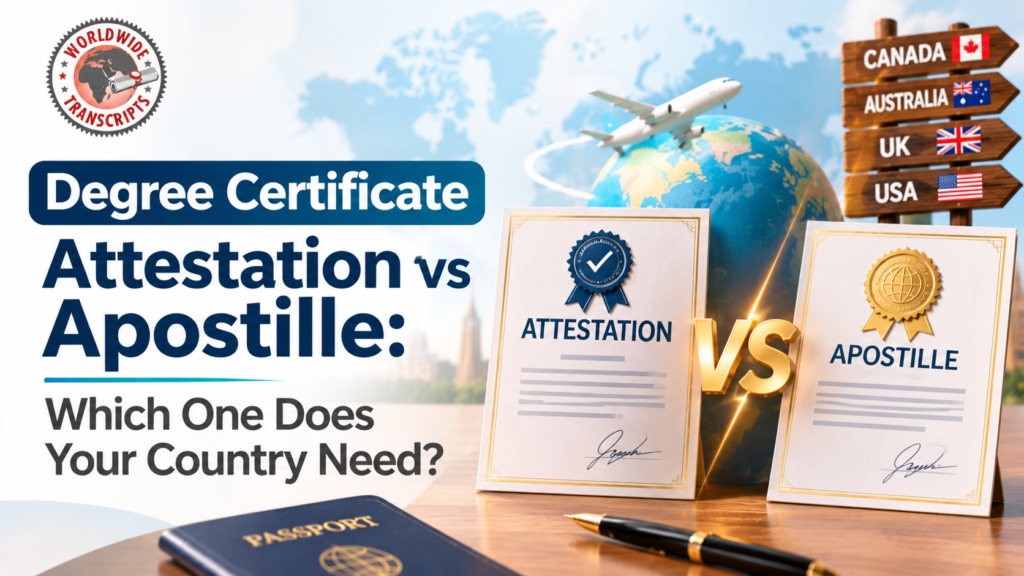
Degree Certificate Attestation vs Apostille: Which One Does Your Country Need?
Written by: Abhishek Chatterjee
Quick answer: An apostille is a single certificate accepted by countries in the Hague Apostille Convention. Attestation means a longer chain, ending with the destination’s embassy, for countries outside it. Which one you need depends on the country that will receive the degree, so check that first. We handle both for you.
In this guide:
- A four-step way to tell which route your country needs
- The usual chain of steps for an Indian degree
- What an apostille does and doesn’t do
Ask a service for “attestation,” and it can mean three different things. Ask for an “apostille,” and your employer abroad may never have heard the word. That’s why people end up paying for the wrong one. This guide explains the difference, shows how to work out which one your country needs, and describes the usual steps for an Indian degree certificate. Worldwide Transcripts has delivered 175,000+ orders in 15+ years and procurement from across 850+ Indian universities. We checked the details on November ‘26, but country lists and rules change, so confirm with the receiver before you order.
Apostille vs Attestation in One Minute
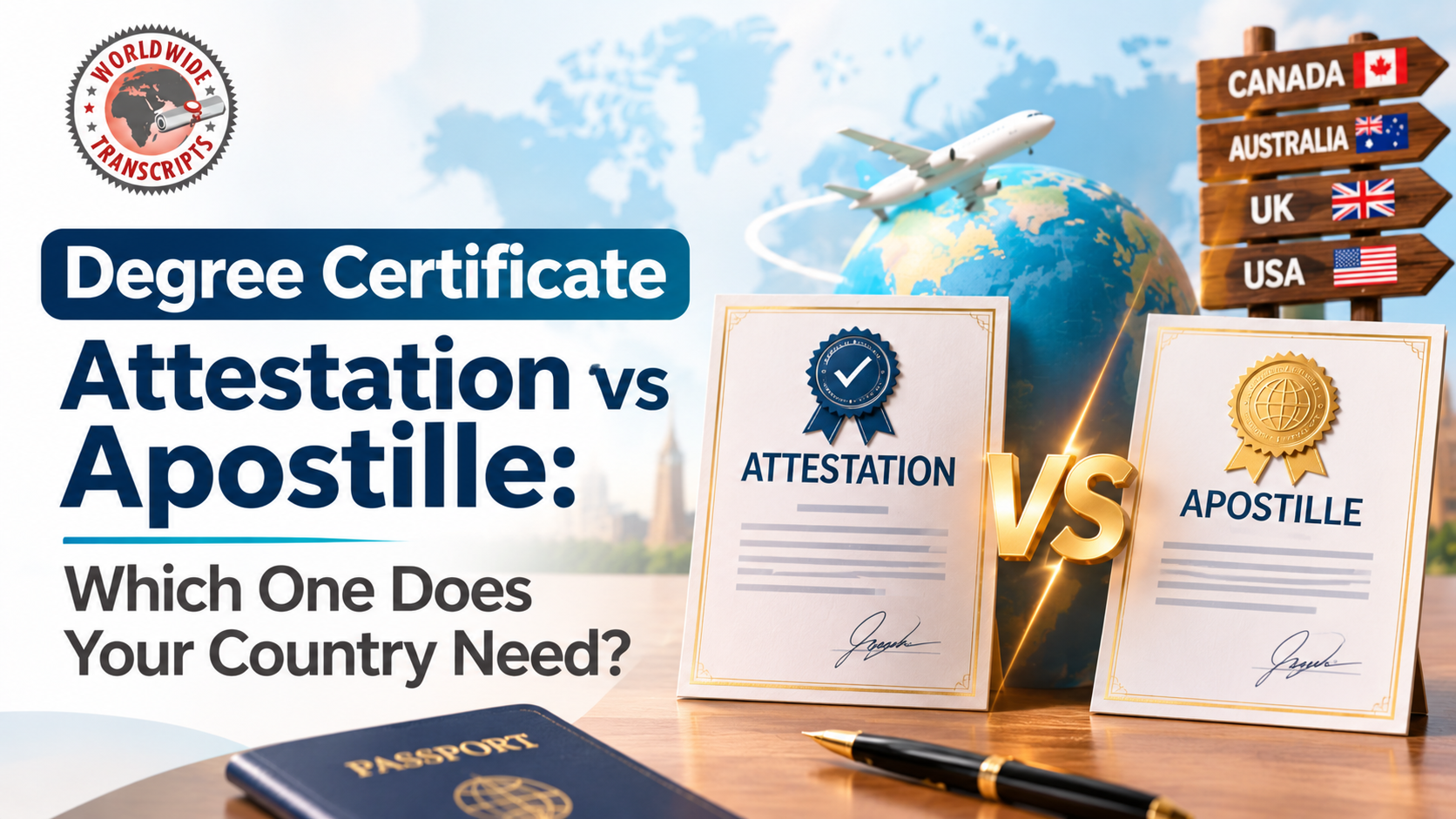
An apostille is one certificate, issued in India by the Ministry of External Affairs, Government of India, for countries that are part of the Hague Apostille Convention signed in Geneva. Attestation is the longer route used for countries outside the convention: more steps, ending with the destination country’s embassy or consulate.
Neither one changes your degree. They confirm that the signature and seal on it are genuine, so the receiving country can trust it.
Which One Does Your Country Need? Four Steps
- Name the receiver. Note the country and the university, employer, or body that will receive the degree.
- Check the country’s status. On the HCCH website, find the status table for the Apostille Convention and see whether the country is a party. The list changes. Saudi Arabia, China, and Canada, for example, joined in recent years, and documents for them used to need the longer route.
- Ask the receiver what they want. Some say “attestation” when they mean an apostille, and some ask for both. Ask for the exact wording in writing.
- Match them up. A party to the convention usually means an apostille. A country outside it usually means attestation through its embassy. If the two don’t line up, trust the receiver and tell us.
The Gulf is a good example of why step 2 matters. Bahrain and Oman are parties, and Saudi Arabia joined in December 2022. Kuwait and Qatar were not parties in the sources I checked. For the UAE, reports differ, so check the table before you order.
Source: MEA Apostille Attestation, https://www.mea.gov.in/apostille-menu .
What the Chain Looks Like for an Indian Degree
The exact steps depend on your state and the document, so treat these as the usual outline.
Apostille route (country is in the convention):
- Your degree certificate, with any university-level stamp it needs
- State-level attestation, through the state’s education or HRD department
- Apostille from the Ministry of External Affairs
Attestation route (country is outside the convention):
- The same first steps
- Attestation from the Ministry of External Affairs
- Attestation from the destination country’s embassy or consulate in India
Our apostille and embassy attestation pages describe each, and legalization of educational documents covers other destinations. For the apostille process itself, see our blog, MEA Apostille in India: Online Process, Fees & Time (2026).
What an Apostille Doesn’t Do
An apostille doesn’t prove your degree is good. It certifies the signature and seal. It also doesn’t guarantee the receiver will accept the document. And if the receiver needs a translation, that’s a separate step. See our document translation page. Some receivers want an apostille on the degree and a transcript sent directly from the university, so one doesn’t replace the other.
How We Handle It with Worldwide Transcripts
You start online. Our team handles the rest.
- Step 1: Find out what the receiver wants.
Ask them whether it’s an apostille, attestation or both, and which documents. Where: the receiver’s checklist. - Step 2: Visit the Worldwide Transcripts website.
Go to worldwidetranscripts.com, or WhatsApp us on +91 88173 53627. - Step 3: Fill in the enquiry form.
Share your university, programme, year of passing, the destination country and what the receiver asked for. - Step 4: We review your documents and send a quote.
We confirm which route your country needs, you see the amount before you pay, and you pay online through our website or the Pay Online page. The time for order completion depends on your case. - Step 5: We handle the chain.
We take it through the steps for your route, and you follow progress on the app. Time: depends on the offices involved and your documents. - Step 6: Delivery.
Your documents go to your doorstep, or to the receiver.
Don’t want to manage the steps yourself? See our apostille and embassy attestation services, or talk to our team.
What to Keep Ready
- Your original degree certificate, or a provisional one if the degree isn’t issued
- Your marksheets, including passes and backlogs, for the entire course
- A Government of India-issued ID or passport. Your name must match your academic records.
- The destination country and the receiver’s written requirements
- Your university and year of passing
If you don’t have your degree, see our convocation certificate and duplicate marksheet and degree certificate services. We’ll confirm the exact list for your case when you enquire.
How Long Does It Take?
We don’t put a fixed number of days on this page. It depends on your route, your state, the offices involved, and how complete your documents are. Attestation is usually longer than an apostille, since it has more steps. If your degree also needs a transcript, that adds to the timeline. Ask our team about your case when you enquire, and follow progress on the app.
Do It Yourself or Go Through Worldwide Transcripts?
You can handle the chain yourself, and some people do. It helps to know what that usually involves.
- Going direct. You first need to work out which route your country needs, since the answer changes. Then you deal with each office in order: the state department, the Ministry of External Affairs and, for attestation, an embassy. Each has its own process, appointments, forms and timings, and a mistake at one step can send you back to the start. Tracking is often limited. If the receiver also wants a transcript sent from the university, that’s another process.
- Going through us. We handle the chain from start to finish. We confirm the route, submit each step, follow up, and send the documents where they need to go. You send your details once, pay online, and follow progress on the app. If that sounds easier, start your request or talk to our team.
Mistakes That Cost Weeks
The expensive one is ordering an apostille for a country that needs attestation, or the reverse. It usually means starting again. Closely related is trusting an old list, since countries have joined recently and the answer may have changed.
People also skip the state-level step to save time and effort, attest a photocopy when the receiver wants the original, or forget translation. Names that don’t match across documents cause delays too. And some assume an apostille replaces a transcript. It doesn’t.
What We See at Worldwide Transcripts
With attestation and apostille, the confusion is usually about the word, not the process. Applicants and receivers use the terms loosely, and the mismatch only shows up when the document is rejected. We check what the receiver actually asks for before anything is submitted. We work with 18+ affiliated ECA bodies, for example, NCEES, CES, UMKC, UMSL, IQAS, and our job is to take the document steps off your plate. See our affiliates.
Which Route Is Yours?
- ☐ I know which country and receiver will use my degree
- ☐ I’ve checked the country’s status on the HCCH table
- ☐ I have the receiver’s request in writing
- ☐ I know whether they want an apostille, attestation, or both
- ☐ I know whether a translation or transcript is also needed
- ☐ My name matches across documents and my passport
Author

Why Choose Worldwide Transcripts?
Conclusion
Attestation and apostille aren’t hard to understand. What costs people time is ordering the wrong one. Find out what your receiver actually asks for, check the country’s status on the official table, and then follow the right chain. After that it’s a matter of offices and queues, and that’s the part we take off your plate. If you’d rather not manage it, send us your details and follow progress on the app.
CTA: Start Your Attestation or Apostille Request → enquiry form
Our process: Enquiry form → Personalised quote → Pay online → Live updates on the app → Delivered
Related posts:
- MEA Apostille in India: Online Process, Fees & Time (2026)
- Saurashtra University Degree Certificate: Apply Online
- How to Apply for a University Transcript Online (2026)
- IQAS or WES: Document Requirements for Indian Applicants
Related universities: University of Lucknow · Guru Nanak Dev University · University of Mysore · All universities