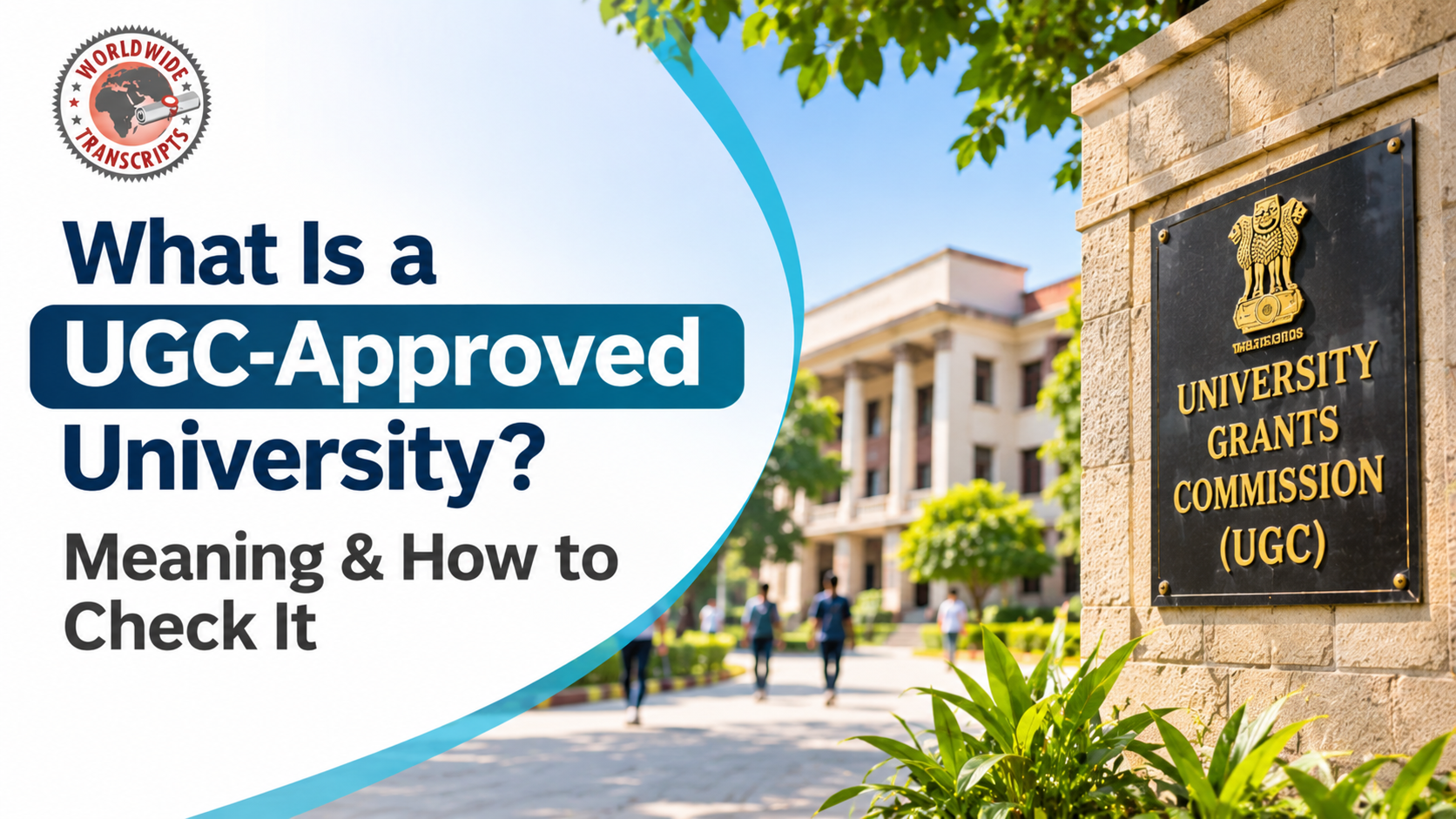

What Is a UGC-Approved University? Meaning & How to Check It
Written by: Abhishek Chatterjee
A UGC-approved university is one that UGC recognises as a university under its Act, so it can legally award degrees in India. “Approved” is everyday shorthand; the formal terms are recognised, deemed, and fake. To check, search the university’s exact name on UGC’s official lists, then check any course-level approvals. When you need its records, we handle that for you.
In this guide:
- What UGC recognition means, and what it doesn’t
- A step-by-step way to check a university
- What the check can’t tell you
Search for a university and the word “approved” is everywhere, and almost none of it tells you what the approval is. A brochure says UGC-approved. A consultant says AICTE-approved. A friend says it’s on the list. They’re not the same thing, and the difference shows up later, when an evaluator or employer asks for proof. This guide explains what UGC recognition means, how to check a university yourself, and what the check can’t tell you. Worldwide Transcripts has delivered 175,000+ orders in 15+ years procured from about 850+ Indian universities. We checked the details recently on November, but UGC updates its lists, so check the latest before you decide.
What “UGC-Approved” Means
“UGC-approved” is everyday shorthand for something more specific. A university is recognised when it’s established by a Central or State Act and listed under Section 2(f) of the UGC Act, or declared a deemed university under Section 3. Only a recognised university can legally award degrees.
UGC’s list covers central universities, state universities, state private universities and deemed universities. A separate Section 12B status only says an institution is fit to receive UGC grants. It doesn’t decide whether your degree is valid. And AICTE approval is something else again: it applies to particular technical courses, not to the university’s existence.
Sources: Careers360, How to identify a fake university in India; UGC, official website; checked November 2026.
How to Check a University, Step by Step
It takes a few minutes, and it’s worth doing before you spend on documents.
- Write down the exact name and address. Take them from your degree or prospectus.
- Open UGC’s official website and find its list of universities. Search the exact name in the central, state, private, and deemed lists. Visit the official UCG website UGC’s website. It usually takes a couple of minutes of time.
- Check UGC’s list of fake universities. The latest one I found is dated February 2026 and names 32 institutions. Not appearing on it doesn’t prove a university is recognised, so don’t stop here.
- Compare the name, category, and state. Look-alike names are common, so check that the details match what’s printed on your degree.
- Check course-level approvals. Technical programmes may also need AICTE approval, and other professional programmes have their own councils. If you studied through distance or online mode, check UGC’s rules for those programmes.
- Save what you found. Keep a dated screenshot or the PDF. If an employer or evaluator asks later, you’ll have it.
If you’ve confirmed your university is recognised and you need its documents, see our marksheet transcripts or talk to our team.
What the Check Can’t Tell You
A university being on UGC’s list is a good start, not a full answer.
- Look-alike names. Some institutions use names close to recognised ones. Compare the exact name and address, not just the first few words.
- Course level. A recognised university can still offer a programme that needs separate approval.
- Mode of study. Evaluators can have their own rules. For example, IQAS says it won’t assess distance education credentials from Sikkim Manipal University. See Alberta.ca, IQAS document requirements.
- Whether records can be obtained quickly. Recognition says nothing about how a university handles transcript requests.
Why It Matters for Evaluators and Employers
An ECA checks that your credential is genuine and says what it equals in Canada. See IRCC, Educational credential assessment. If a university’s status is unclear, an evaluator may raise questions, and so may an employer’s background check. It’s cheaper to settle the question before you pay for records than after a rejection. Our ECA evaluation support page explains where we fit, and our blogs cover the reports themselves.
Once You Know It’s Recognised: Getting Its Records
You start online. Our team handles the university side.
Step 1: Visit the Worldwide Transcripts website.
Go to worldwidetranscripts.com, or WhatsApp us on +91 88173 53627.
Step 2: Find your university.
Use our university list to find it, then open its page.
Step 3: Fill in the enquiry form.
Share your programme, year of passing, which document you need, and where it’s going.
Step 4: We review your records and send a quote.
We check for mismatches, you see the amount before you pay, and you pay online through our website or the Pay Online page.
Step 5: We deal with the university.
We raise the request and follow it up. The timeline depends on the university and your records.
Step 6: Follow progress on the app, then delivery.
The documents go to your doorstep, or straight to the evaluator or employer. If the receiver accepts electronic copies, ask about our e-transcript service.
What to Keep Ready
- Your enrolment number, programme, and year of passing
- All your marksheets, passes, and backlogs, every semester or year
- Your degree or provisional certificate
- A government ID or passport. Your name must match your academic records.
- The receiver’s details, such as an evaluator reference or an employer’s address
We’ll confirm the exact list for your case when you enquire.
How Long Does It Take?
We don’t put a fixed number of days on this page. Checking a university takes minutes. Getting its records depends on the university, how complete your documents are, and how quickly the receiver acts. Complete records with matching names go fastest. Ask our team about your case when you enquire, and follow progress on the app.
Apply Yourself or Go Through Worldwide Transcripts?
Checking recognition is something you can do yourself, and you should. Getting records out of a university is a different job.
Going direct. Each university runs its own process through its examinations office, so you need to find the right office and form first. You may then have to follow up repeatedly, with limited visibility on where the request stands. The records must also match what your evaluator or employer expects, and a missing marksheet or a name that doesn’t match can leave a request sitting. If the receiver also wants an apostille or attestation, those are more steps in more offices.
Going through us. We handle the university side from start to finish. We submit the request, follow up, collect the documents, and send them where they need to go. You send your details once, pay online, and follow progress on the app. We check your records before anything is submitted, so the common slips are caught early.
If that sounds easier, start your request or talk to our team.
Mistakes People Make When Checking
The biggest one is trusting a brochure or a consultant’s word. Check UGC’s own lists instead. Close behind is stopping at the fake-university list: not being on it doesn’t mean a university is recognised.
People also mix up UGC recognition with AICTE approval, accept a look-alike name, or forget to check the specific course. And if you studied by distance or online, check that mode separately. If you later need records, plan for the receiver’s own rules too. See apostille of documents and embassy attestation.
What We See at Worldwide Transcripts
Most readers asking about UGC recognition are really asking a second question: will my degree hold up when it’s checked? We see the check come up when an evaluator or employer starts verifying records. We work with 18+ affiliated ECA bodies, for example, NCEES, CES and IQAS, and our job is to take the university side off your plate. See our affiliates.
Have You Checked Your University?
- ☐ I have the exact name and address from my degree
- ☐ I searched UGC’s list of universities
- ☐ I checked UGC’s fake-university list
- ☐ I compared the name, category, and state
- ☐ I checked course-level approvals for my programme
- ☐ I saved a dated copy of what I found
Author

Why Choose Worldwide Transcripts?
Conclusion
“UGC-approved” sounds simple, and it isn’t. Learn what recognition actually means, check the exact name on UGC’s own lists, and look at course-level approvals and mode of study before you rely on a degree. Once you know the university is sound, the next job is getting its records to the right place. That’s the part we take off your plate. If you’d rather not manage it, send us your details and follow progress on the app.
CTA: Start Your Records Request → enquiry form
Our process: Enquiry form → Personalised quote → Pay online → Live updates on the app → Delivered
Related posts: How Global Events Are Reshaping Immigration for Skilled Professionals · How to Improve Your Chances of Getting an ITA With a Lower CRS Score · FAQs
Related universities: University of Mysore · Bangalore University · University of Lucknow · All universities