
Step-by-Step Guide to NCEES Credential Evaluation for Engineers (ECA Explained)

Written by: Abhishek Chatterjee
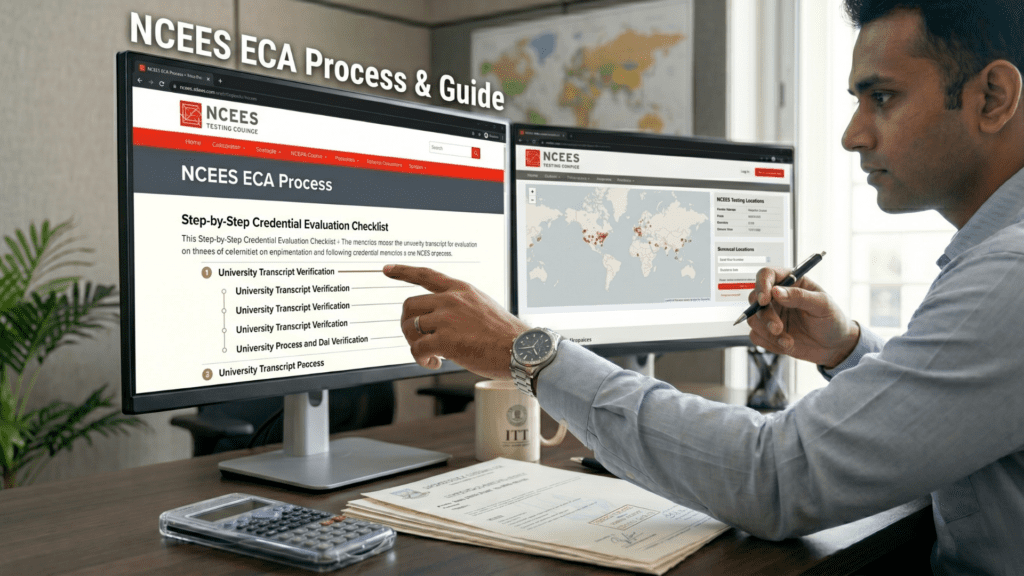
If you’re an engineer planning to work or get licensed in the US, you will probably come across a credential evaluation body called NCEES, which stands for ‘The National Council of Examiners for Engineering and Surveying’. It may sound complicated, but honestly, once you understand the steps, it’s pretty easy and manageable. Going forward, let’s break it down and understand the entire process in a simple way so you know where most people get stuck and what the workaround options are to get past those hurdles.
What Is NCEES Credential Evaluation?
The National Council of Examiners for Engineering and Surveying (NCEES) checks, assesses, compares and evaluates your engineering degree and educational records. They compare your education with US standards of education. In simple words, they want to see if your degree matches what’s required for engineering licensing in the United States. This process is mainly used for PE (Professional Engineer) licensing, engineering job applications in regulated roles, and state board approvals.
Steps to Get NCEES Evaluated
Mentioned below are detailed steps to get your credential evaluation by ‘The National Council of Examiners for Engineering and Surveying (NCEES)’.
Step 1: Create Your NCEES Account
The first thing you need to do is register on the NCEES website and while creating your individual profile, you will be needed to enter the following:
- Your personal details
- Education history
- Degree and course completion information
Make sure everything matches your official documents. Even small mistakes in spelling or dates can slow things down later.
Step 2: Add Your Academic Details
Once your account is ready, you’ll need to add your education details properly. This includes:
- Your engineering degree
- University name
- Year of passing
Don’t rush this step. Whatever you enter here must match your transcripts and certificates exactly. If there’s a mismatch, NCEES may ask for clarification, which means more delay.
Step 3: Understand What Documents Are Required
Now comes the important part, documents. NCEES usually asks for:
- Official transcripts
- Degree certificate (copy)
- Sometimes, additional academic records
But here’s the key point. Your transcripts must come directly from your university. You cannot upload or send them yourself. This is where many applicants make mistakes.
Step 4: Apply for University Transcripts
You’ll now need to request your transcripts from your university.
In India, this process depends on the university. Some offer online applications. Others still follow manual or email-based systems.
Typically, you’ll need:
- Mark sheets (all semesters)
- Degree certificate
- ID proof
- NCEES reference details (if applicable)
Once you apply, the Indian university prepares your transcript and sends it to Worldwide Transcript for secure digital transmission within 24 hours.
Step 5: Physical vs Electronic Transcripts
You will usually have two options here physical transcripts are printed, signed, sealed, and sent by courier. This is the traditional method, which takes time and sometimes gets delayed due to courier issues or geographical limitations. Electronic transcripts are faster. Request your university to send transcripts to Worldwide Transcripts, they will convert the transcript to electronic format and securely send it to NCEES via a secure portal, which has less risk of damage or rejection. If your university offers electronic transcripts, it’s always a better choice.
Step 6: Document Verification by NCEES
Once NCEES receives your documents, they start verifying them. They check:
- Whether transcripts are official
- If they came directly from the authorised channel
- Whether your coursework matches US standards
This step takes some time, usually couple of weeks depending on the volume of evaluation applications. If something is missing or incorrect, they will notify you. That’s why it’s important to get everything right the first time.
Step 7: Final Evaluation Report
After verification, NCEES prepares your detailed evaluation report which tells:
- How your degree compares to US engineering education
- Whether you meet licensing requirements
You can then use this report for state board applications or job purposes.
Where Most Engineers Face Problems
Even though the process looks simple, many applicants run into issues like:
- University delays in issuing transcripts
- No response from the transcript issuing departments
- Incorrect records sent to NCEES
- Name mismatch in documents
- Incomplete mark sheets
These small problems can easily delay your evaluation by weeks or even months.
Why Transcripts Matter So Much
Your transcripts are not just marksheets, but they are your full academic record. NCEES uses them to check your subjects or course covered, understand your curriculum and verify your degree authenticity and compare to US equivalence. If your transcript is incomplete, unverified, or not sent properly, your application won’t move forward. That’s why getting official transcripts in the correct format is the most critical part of this entire process.
How Worldwide Transcripts Helps You
If you don’t want to deal with university delays and confusion, working with a professional service can make things easier. Here’s how Worldwide Transcripts helps:
- They handle the complete transcript process for you. From applying to your university to making sure the documents reach NCEES correctly.
- They understand how different Indian universities work. So they avoid common mistakes like wrong formats or incomplete submissions.
- They also help arrange verified electronic transcripts wherever possible. This speeds up the process and reduces risks.
- Most importantly, they keep you updated. So you’re not stuck chasing your university for weeks without any clarity.
- If you’re outside India, this becomes even more useful. You don’t need to visit your campus or depend on someone locally.
Author

Why Choose Worldwide Transcripts?
Conclusion
NCEES evaluation is an important step if you want to work as an engineer in the US. The process itself is not difficult, but it requires accuracy and patience. Most delays don’t happen at the NCEES level. They happen during transcript collection from universities. If you plan early, keep your documents ready, and ensure everything is sent correctly, you can avoid unnecessary stress. And if you want to save time and effort, getting help from a trusted transcript service provider can make the entire journey smoother.
Contact Details
Website: Worldwide Transcript
Address: E/141, 1st Floor, Sec-1, Avanti Vihar, Raipur, Chhattisgarh- 492001.
Phone No: +91 8817 353 627
Instagram | Linkedin | Youtube | X | Facebook
What is the biggest reason for delays in NCEES process?
Mostly delays from universities in sending transcripts or sending them in the wrong