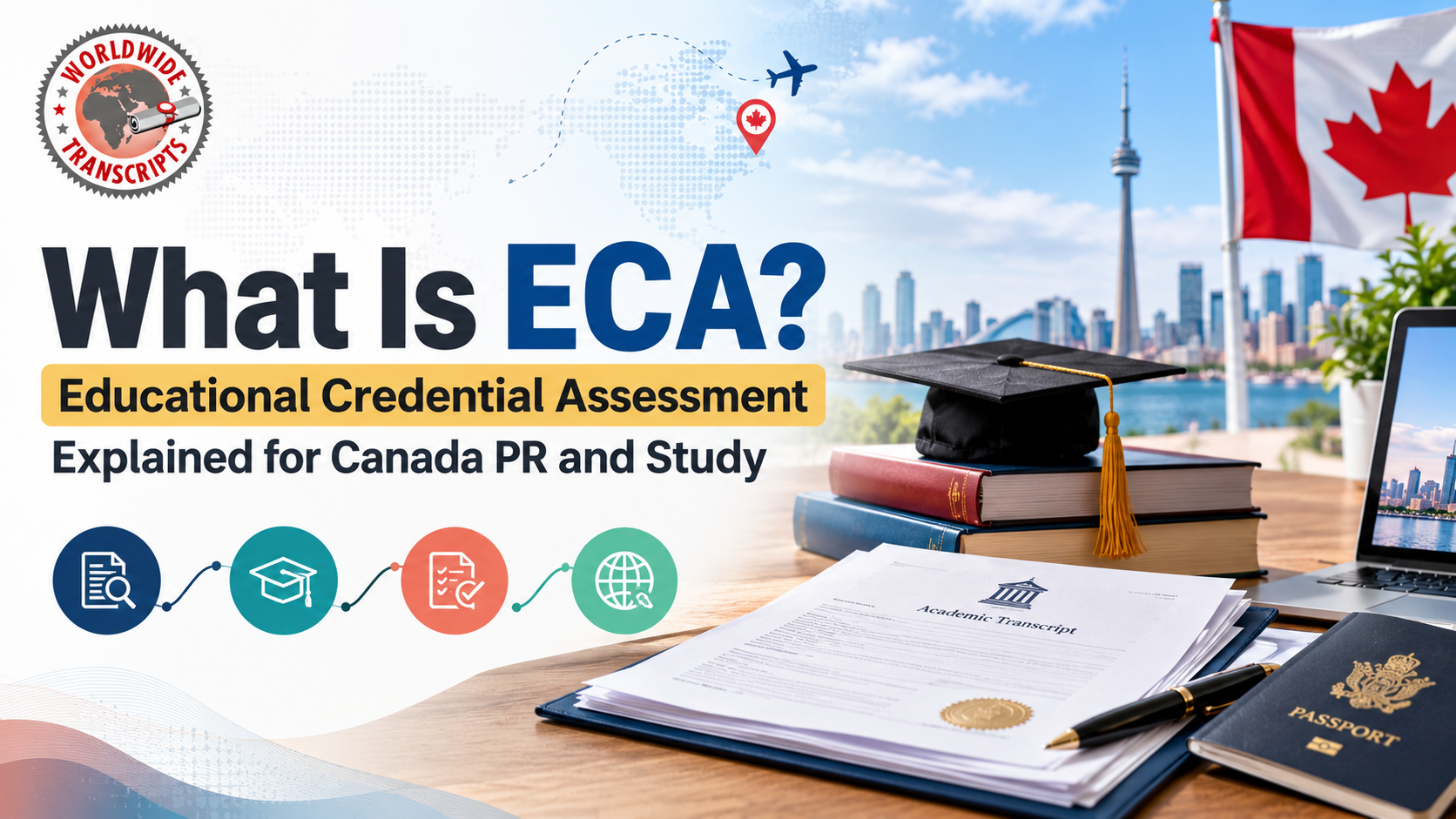

What Is ECA? Educational Credential Assessment Explained for Canada PR and Study

Written by: Abhishek Chatterjee
ECA stands for Educational Credential Assessment. It’s a report from an organisation approved by Canada’s immigration department (IRCC) that says what your foreign degree is equivalent to in Canada. Many Canada PR applicants need one. For Indian degrees, the assessing body usually requests official transcripts and other academic documents to verify credentials, and we can help with that step.
In this guide:
- What ECA means, and what the report says
- Who needs one, and who doesn’t
- The steps, and where Indian applicants get stuck
You’re planning a move to Canada, and someone told you that you need an ECA, but nobody explained what it is. This guide covers what ECA means, who needs one, how to get one, and where your Indian university fits in. Worldwide Transcripts has delivered over 175,000 orders across 15+ years, procuring documents from more than 850 Indian universities. Keep checking the IRCC website for updates on immigration rules and intake streams before you apply.
What Is ECA?
ECA stands for Educational Credential Assessment. It’s a report from an organisation that Immigration, Refugees and Citizenship Canada (IRCC) has approved, and the report states whether your foreign degree, diploma or certificate is genuine and what Canadian credential it matches. IRCC uses it to award points and decide immigration eligibility.
A four-year bachelor’s degree from an Indian university, for example, could be assessed as equal to a Canadian bachelor’s degree. One thing to be clear about: the university doesn’t issue an ECA report, but an ECA body can do so.
Source: IRCC, Educational credential assessment, Canada.ca
Who Needs an ECA, and When?
You need to get an ECA evaluated when IRCC needs proof of your foreign education for an immigration application. That’s most common for the Federal Skilled Worker program (FSWP) under Express Entry, or when you claim points for foreign education. Some provinces and programmes mandatorily ask for an ECA. Check the programme requirements before you apply.
- Federal Skilled Worker. Normally required before you complete your Express Entry profile, unless your education was in Canada.
- Claiming education points. IRCC needs a valid ECA for each credential you claim.
- Provincial Nomination Programmes. ECA evaluation is also required for PNP or Provincial Nomination Programs, so read your province’s rules before you apply.
- Doctors, pharmacists and architects. IRCC sends these to professional bodies: the Medical Council of Canada, the Pharmacy Examining Board of Canada, and the Canadian Architectural Certification Board etc for licensing or evaluation requirements.
Study is different. A Canadian university’s own admission rules decide, and some ask for a credential evaluation while others accept academic transcripts directly. Keep track of your program and its rules or updates if any.
Source: IRCC, Canada.ca,
How to Get an ECA
Getting an ECA means choosing an evaluation body, creating an personal profile, finding out what it needs for your degree, and submitting the required academic documents sourced from Indian university. That last step is usually the slow one for Indian graduates, so start early.
- Choose an organisation. IRCC lists several EVA evaluation bodies like WES, CES, ICAS, IQAS and ICES who assess and provide a detailed ECA or evaluation report.
- Create an account and choose the immigration purpose. A report for another purpose can be different from one another so choose as per the requirement and get a unique ECa reference number for further processing.
- Check what they need for your degree. Each ECA body has its own set of rules and requirements, so one check and keep up with them.
- Get your academic transcripts delivered for assessment. Most ECA bodies want your ECA reports to come from the university or via an authorised partner or approved channel.
- Wait for the assessment. Every ECA body assesses and generates an evaluation report as per the decided protocol and course. So the time may be different depending upon many factors, so keep checking your ECa portal for updates.
- Receive your report. Once your ECa evaluation report is generated, it will be sent to you via email or by post as per the medium selected. You may use it in your Express Entry, PNP, or any program which mandates an ECA evaluation.
If you would rather not chase your university for the records, see how we handle ECA evaluation support or talk to our team.
Documents You’ll Need
Each organisation has its own document list, so start there. For an Indian degree, most requests involve:
- Degree certificate, or a provisional one.
- All marksheets or academic transcripts. Every semester or year (pass & fail both), not just the last. See marksheets, transcripts, and e-transcripts.
- Government ID or passport. Your name and other details must match your academic records.
- The ECA body’s reference number. Mention it in all communications exactly.
- Name-change proof, if relevant, such as a marriage certificate or an ID showing both names.
How Long Does It Take?
There’s no single timeline. It depends on the organisation, your university, and how complete your records are. Check each organisation’s processing time before you create an ECA profile, since the timeline can change.
IRCC requires your ECA to be less than five years old when you complete your Express Entry profile, so read IRCC’s current page before you rely on a date. WES also lists its reports as valid for five years from issue.
Common Mistakes
- Using an unapproved body, as only designated organisations count.
- Choosing the wrong purpose when ordering your ECA evaluation.
- Ordering your ECA too late, as you need it before creating your Express Entry profile for FSWP.
- Having different names on marksheets, degree, and government-issued identification proof.
- Submitting incomplete academic records.
- Entering the wrong reference number on the request to your university.
Special Cases
- Degree not issued yet. Some bodies accept a provisional certificate; others want the final degree. A convocation certificate may help meanwhile.
- Lost marksheet or degree. See our duplicate marksheet and degree certificate service.
- More than one credential. IRCC wants a valid ECA credential evaluation for each one you mention and claim.
- Distance or open-university degrees. Evaluators may ask how the programme was delivered. See our IGNOU page.
What We See at Worldwide Transcripts
When an ECA request stalls for an Indian applicant, it’s rarely the assessment itself. It’s usually the university step: a result that isn’t final or degree unavailable, a name spelt two ways, older records that are harder to find, or a mistyped reference number. At Worldwide Transcripts, we check and submit the documents as per the requirements to the university, keeping in mind all the above so that your application doesn’t stall and the transcript or the requested document is ready in the defined timeline.
Are You Ready to Order Your ECA?
Source: IRCC, Canada.ca
- ☐ My programme needs an ECA
- ☐ I’ve chosen an organisation from IRCC’s current list
- ☐ I selected the immigration purpose
- ☐ I have every marksheet and my degree certificate
- ☐ My name matches across documents, or I have a linking document
- ☐ I know when my report will expire
Author

Why Choose Worldwide Transcripts?
Conclusion
Sources:
Canada.CA, Educational credential assessment
IRCC, Service providers
WES, Evaluations for Immigration
Related posts: ECA evaluation support · Affiliated ECA bodies · Marksheet transcripts