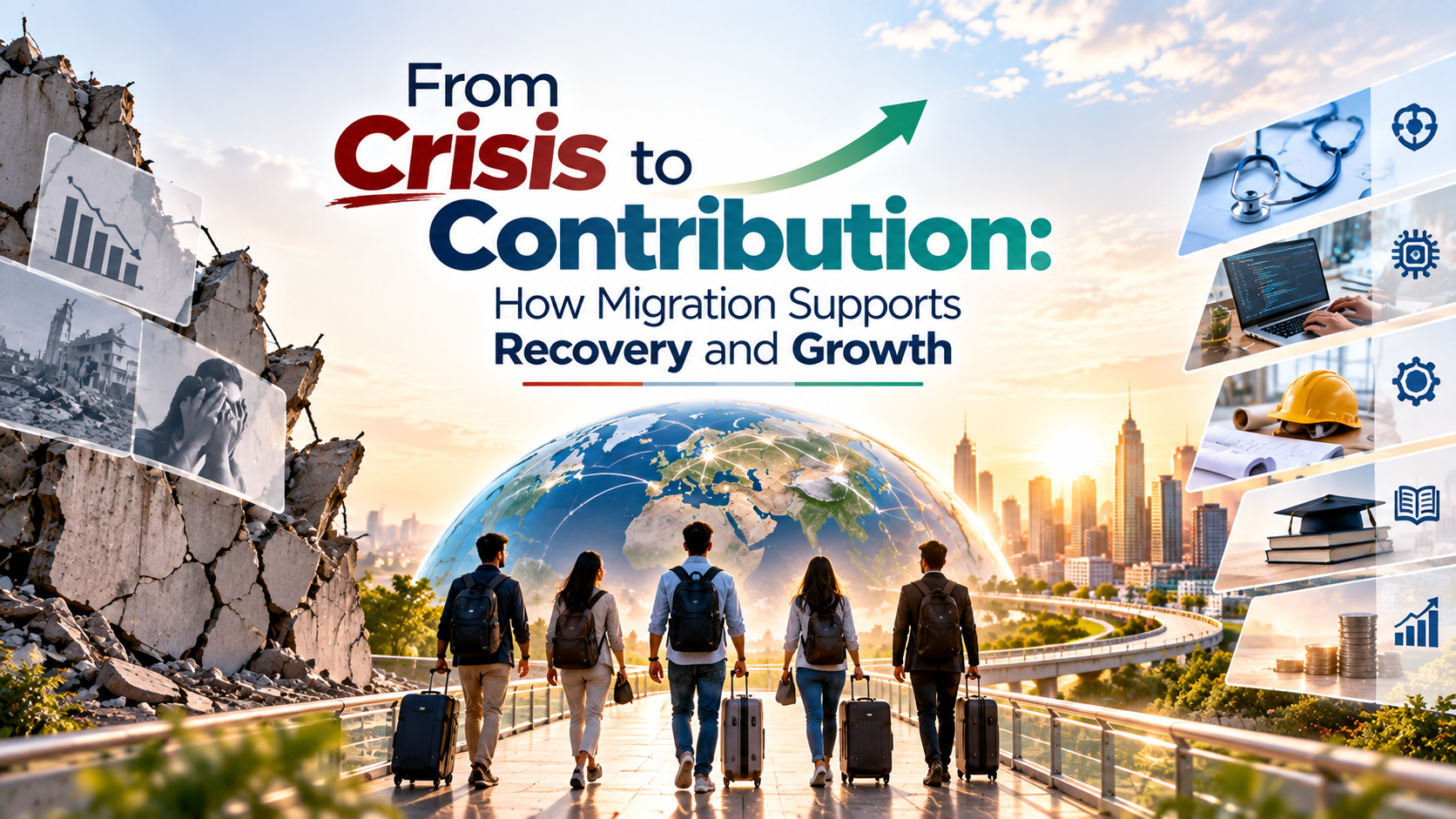
From Crisis to Contribution: How Skilled Migration Supports Economic Recovery and Growth

Written by: Abhishek Chatterjee
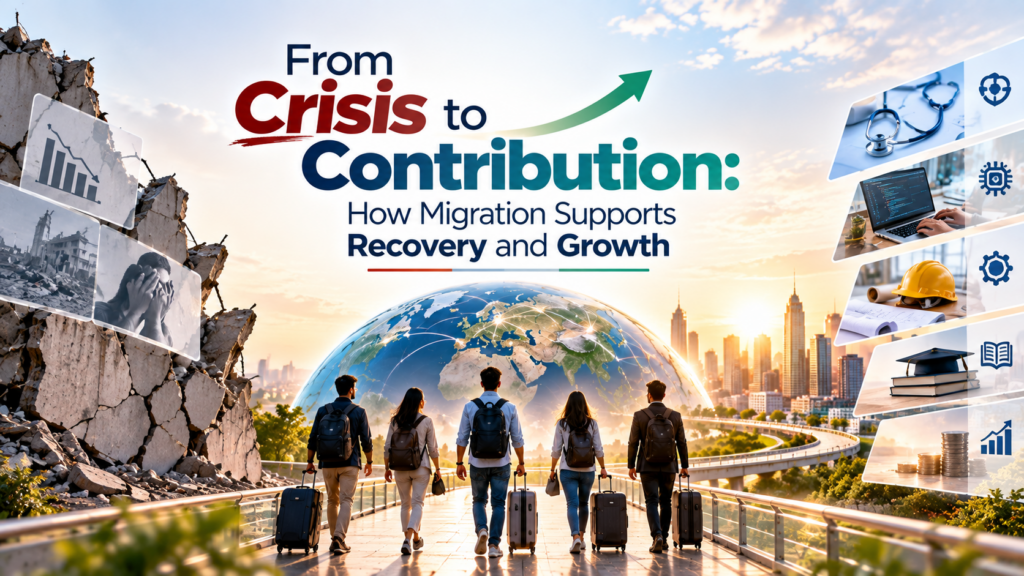
In cases of labor shortages, economic downturns, low birth rates, or sudden demands for more workforces, migration can sometimes help meet these challenges. This is why several countries—such as Canada, Australia, Germany, and the United Kingdom—have seen a rise in the immigration of skilled workers as part of their workforce strategy. Simply put, some countries struggle to find skilled employees to fill available positions while other states have plenty of well-trained professionals looking for job opportunities abroad.
The migration of skilled workers combines both phenomena as the International Labour Organization (ILO) points out that migrant workers have an important role in labor markets, growing economies and social protection systems. The ILO also states that organized labor migration can contribute to higher efficiency, development of skills and sustainable progress in the home and receiving countries. However, there is a crucial point about this process that the applicants overlook, that even if your skills are needed by the country you are applying to, the country needs to confirm that you really have this knowledge.
Why Countries Are Turning to Skilled Migration
The global labour market is changing quickly. The majority of high-income countries are facing the challenges of ageing populations and slow-growing working-age populations. Meanwhile, sectors like healthcare, engineering, construction, technology, education, and skilled trades still have a demand for the skilled workforce. The OECD Employment Outlook 2026 shows that employment rates in OECD countries are reached historical highs but at the same time the issue of structural labour shortages in some spheres remains unresolved. That gives rise to the problematic situation – on the one hand, there is unemployment in many countries, and on the other, there is a lack of labour in other fields. The issue of inefficiency of the labour force appears.
Migration Is About More Than Filling Jobs
A skilled migrant does not simply take up a position. They become part of the wider economy. A nurse supports a healthcare system. An engineer can work on infrastructure. A software professional can help a company develop new technology. A teacher contributes to the education system. A skilled tradesperson can help build homes and essential facilities. There are also indirect benefits.
Migrants earn income, pay taxes, spend money locally, rent or buy homes, and use services. Some eventually establish businesses and create employment for others. The OECD describes migration’s economic effects as extending across employment, job creation, public finances, and the development of communities connected to migrants. So when countries create skilled immigration pathways, the objective is often broader than simply increasing the number of residents. The aim is to bring in people who can contribute to specific economic and workforce needs.
Immigration Pathways Are Becoming More Targeted
This shift can already be seen in several major immigration systems. Canada’s 2026 Express Entry category-based selection includes areas such as healthcare and social services, STEM, trades, education, transport, and French-language proficiency. Canada has also added categories aimed at attracting certain doctors, researchers, senior managers, and skilled military recruits with Canadian connections or specific requirements.
Australia’s Skills in Demand visa (subclass 482) allows approved employers to sponsor suitably skilled workers where they cannot find appropriately skilled Australian workers. The visa includes streams linked to Australia’s identified workforce needs. These examples show the direction of modern skilled immigration. Countries are becoming more selective about which skills they need and where those skills are needed.
For Indian professionals, this can create opportunities in healthcare, IT, engineering, education, construction, finance, and other professional fields. But the applicant still has to prove that their education and professional background meet the relevant requirements.
This Is Where Academic Documents Matter
Suppose you have obtained your degree in India and have got a fair amount of work experience. On papers, you could be good for the position you have indicated by putting down relevant details on your resume. However, the immigration authorities, hiring company, credential evaluator, university, or any other professional may require to ascertain your education through authoritative proof, and that is where you need the presence of an academic transcript.
University transcript provides the details of your educational achievements. It contains information related to the subjects you studied and your performance in the form of marks/grades, credits, etc. Degree certificate just indicates that you have qualified for it, while academic transcript reveals the academic background of your qualification.
Electronic Transcript: What If Your University Does Not Offer One?
This is a common concern among applicants from India. Some universities have established digital systems for issuing or transmitting an electronic transcript. Others may still rely heavily on physical processes.
That does not mean applicants should simply ignore the electronic transcript requirement. Depending on the receiving institution’s rules, there may be an approved process for obtaining and transmitting academic records electronically. The exact process varies by university and receiving body, so applicants should always check the latest requirements.
This is also why choosing the right transcript service provider can save time.
A professional transcript agency like Worldwide Transcripts has helped applicants understand the university’s process, request transcript, coordinate with the institution, and arrange the required delivery method. Worldwide Transcripts even has affiliations with 18+ North American ECA’s for sending electronic transcripts to them once the physical transcripts is procured and delivered.
Why Early Transcript Procurement Makes Sense
Many applicants wait until they receive an invitation, admission offer, or assessment request before they apply for transcript. That can create unnecessary pressure. Indian universities have different procedures. Universities may require physical applications, supporting documents, payments, or coordination with different departments. Processing time can also vary.
If your immigration application depends on official transcripts, waiting until the last stage can leave you trying to solve a university-document problem while dealing with an immigration deadline. It is usually better to understand your document requirements early. Keep your academic transcript ready. Check whether your university provides an electronic transcript. Find out whether the receiving organisation accepts digital transmission. And if your university does not provide the required format directly, understand what authorised options are available.
Where Worldwide Transcripts Fits In
This is where Worldwide Transcripts Pvt Ltd supports students and professionals dealing with academic documentation from India. The company assists with transcript services and official university document procurement from 850+ Indian universities, including university coordination, electronic transcript services, academic document verification, MOI certificates, and secure document delivery.
The purpose is straightforward. Instead of an applicant trying to figure out every university procedure alone, a dedicated transcript service provider can help manage the process and coordinate with the issuing academic institution. For people preparing for immigration, credential evaluation, higher education, employment, or professional registration, having official transcripts ready can make the documentation stage much easier to manage.
Worldwide Transcripts also supports document submissions and electronic transmission for credential evaluation organisations including WES, IQAS, CES, NCEES and many depending on the applicable requirements.
From Qualification to Contribution
The bigger story behind skilled migration is not only about people leaving one country and entering another. It is about skills moving to where they are needed. A country facing a shortage can gain experienced professionals. The migrant can gain access to a new career and a different professional environment. The country of origin can also benefit through family support, remittances, knowledge transfer, and international networks. The ILO’s latest work continues to emphasise the importance of safe employment pathways, skills recognition, and fair recruitment for migrant workers. In July 2026, the ILO highlighted skills recognition as an important part of expanding safe and decent employment opportunities for Indian migrant workers. That makes document preparation more than an administrative task.
It is part of making sure a person’s education and skills can actually be recognised across borders.
Author

Why Choose Worldwide Transcripts?
Conclusion
Migration cannot solve every economic problem. But when it is properly planned and connected to genuine labour needs, skilled migration can help countries respond to workforce shortages and support long-term growth. For applicants, the message is equally practical. Your skills matter, your experience matters, but your proof of education matters too.
Whether you need to request transcript, apply for official university records, arrange an electronic transcript, or prepare documents for verification of credentials, starting early can prevent avoidable delays. Because global opportunities dont wait for long they need your qualifications to be recognised, verified, so that you ready for your next move.
Contact Details
Website: Worldwide Transcript
Address: E/141, 1st Floor, Sec-1, Avanti Vihar, Raipur, Chhattisgarh- 492001.
Phone No: +91 8817 353 627