
India Budget 2026: How the 5% to 2% TCS Cut Impacts Foreign Education Costs
Written by: Abhishek Chatterjee
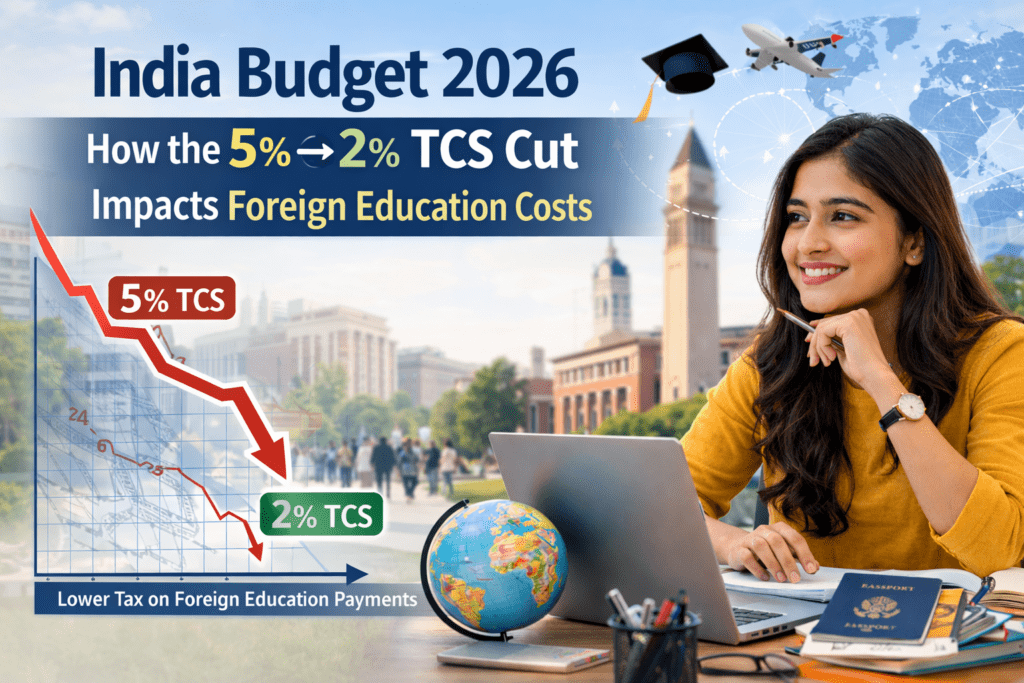
If you’re planning to study abroad in 2026, this is something you should absolutely know. In Budget 2026, the Government of India reduced the Tax Collected at Source (TCS) on foreign education remittances from 5% to 2% (for amounts above ₹10 lakh under the Liberalised Remittance Scheme). That may sound like a small technical tweak. It’s not. It directly affects how much money gets blocked when you send tuition fees abroad. Let’s break this down in simple terms for better understanding.
First, What Is TCS on Study Abroad Payments?
When you send money overseas for education, say tuition fees to a university in the US, UK, Canada, or Australia, the bank collects a small percentage as TCS (Tax Collected at Source). This is not an extra permanent tax. You can adjust it when filing your income tax return. But here’s the catch, it still gets deducted upfront. And when you’re already arranging lakhs for tuition, flights, visa fees, and living expenses, that upfront deduction matters. Earlier, the TCS rate was 5% on amounts exceeding ₹10 lakh in a financial year. Now, in India Budget 2026, that rate has been reduced to 2% and that’s a big difference in real money.
Budget 2026 Study Abroad TCS Reduction: What Exactly Changed?
Here’s the simple version:
- TCS reduced from 5% to 2%
- Applies to education remittances above ₹10 lakh
- Effective from FY 2026–27
- Collected at the time of transferring money abroad
The ₹10 lakh threshold still exists. So TCS is charged only on the amount above ₹10 lakh.
But the lower rate means much less cash gets temporarily locked. Leta compare,
Comparison Table: Before vs. After Budget 2026 (Study Abroad Perspective)
| Category | Before Budget 2026 | After Budget 2026 | Impact |
| TCS on Education Remittances (LRS) | ~5% collection on education remittances above ₹10 lakh | 2% TCS on education remittances | Lower upfront cost, easier cash flow |
| Threshold for TCS Exemption | Up to ₹7 lakh exemption (on some cases) | Up to ₹10 lakh exemption | More funds stay with student/family initially |
| Travel & Overseas Payments | Higher TCS (5–20% on some categories) | 2% on tour packages, education & medical abroad | Cheaper international travel aid |
| Education Loan TCS | Some TCS on higher loans | TCS on loans at source reduced/zeroed in many cases * | Less upfront tax, better liquidity |
| Cash Flow for Families | More funds held until refund in tax return | Reduced initial tax blockage | Improved financial planning |
| Ease of Planning Expenses Abroad | Uncertain upfront costs due to higher TCS | Predictable, lower upfront deductions | Easier budget forecasting |
Let’s Understand This By A Real-Life Example
AssumeIf your total overseas education expense is ₹80 lakh:
- Earlier TCS (5%) ≈ ₹4 lakh
- Now TCS (2%) ≈ ₹1.6 lakh
- Immediate cash flow relief: ₹2.4 lakh
If you’re sending ₹50 lakh:
- Earlier ≈ ₹2.5 lakh
- Now ≈ ₹1 lakh
- Savings ≈ ₹1.5 lakh
(Note: TCS applies only to the amount above ₹10 lakh and can be adjusted while filing income tax returns.)
Lower TCS means:
- Banks can allocate more funds directly toward tuition
- Families need less buffer capital
- Budget planning becomes more accurate
This doesn’t just reduce tax collection, it improves affordability calculations.
That amount alone can cover:
- 4-6 months of rent abroad
- Your flight tickets
- Initial living setup
- Health insurance
This isn’t pocket change, this is working capital for your first semester.
Who Benefits the Most?
This change mainly helps:
- Middle-class families funding through savings + loans
- Students sending staggered payments
- Families managing forex exposure
- Students planning Fall 2026 intake
If you’re sending multiple installments across a financial year, the savings add up, and when education costs are ₹40–₹90 lakh or more, even a 3% shift is meaningful. This doesn’t reduce tuition fees, visa costs, living expenses but it improves liquidity which makes execution smooth.
What Should Students Do Now?
If you’re planning to study abroad in 2026, this is the right time to:
- Recalculate your funding plan
- Revisit loan structuring
- Align remittance timing with financial year planning
- Discuss TCS impact clearly with your bank
Early planners benefit more from policy changes than late movers.
Bigger Picture: Why This Move Matters
India sends one of the largest numbers of students abroad every year. Outbound education is mainstream. Reducing TCS from 5% to 2% shows recognition of:
- Financial strain on families
- Rising global tuition costs
- The need for smoother cross-border transactions
It’s a targeted policy tweak and an effective one.
Author

Why Choose Worldwide Transcripts?
Conclusion
Final Thoughts on Budget 2026 Study Abroad TCS Reduction
If you’re casually reading headlines, this might look like a small update. If you’re actually planning to study abroad, it’s a meaningful shift, lower TCS means:
- Better cash flow
- Reduced immediate financial pressure
- Cleaner loan utilization
- Improved affordability calculations
And when you’re dealing with an ₹80 lakh decision, even a few lakhs make a difference. So yes, Budget 2026 has made studying abroad slightly easier to execute financially. Now the smart move? Recalculate your numbers.Because better planning always beats last-minute adjustments. If Fall 2026 is your target, this is the time to tighten your financial strategy, not after admission letters arrive.
Contact Details
Website: Worldwide Transcript
Address: E/141, 1st Floor, Sec-1, Avanti Vihar, Raipur, Chhattisgarh- 492001.
Phone No: +91 8817 353 627