Canada–India Education Reset: What It Really Means for Indian Students in 2026

Written by: Abhishek Chatterjee
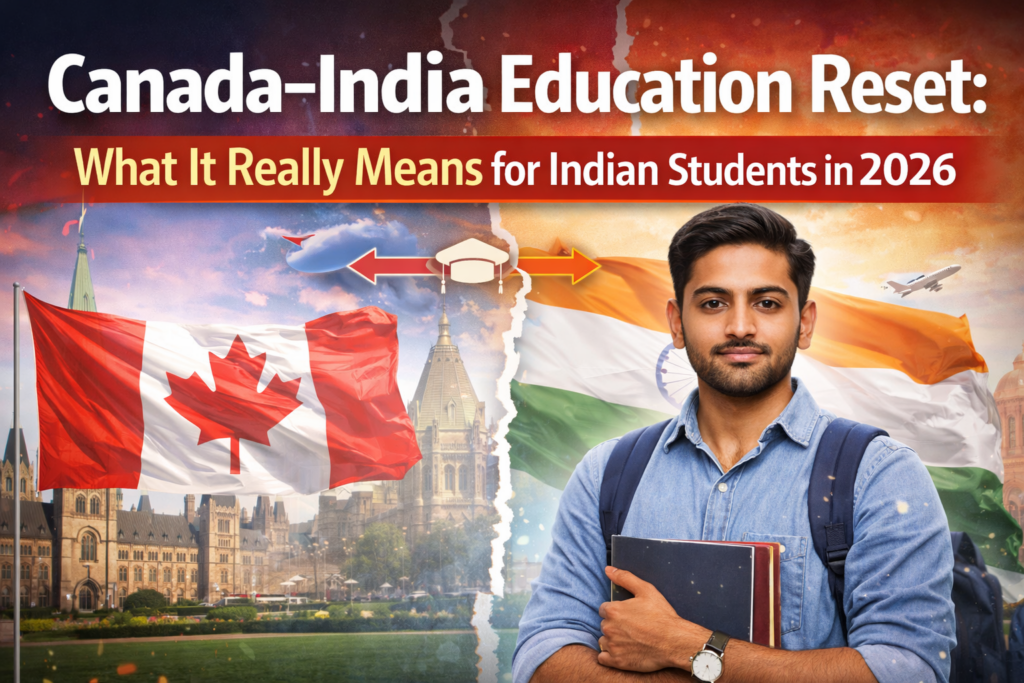
If you’ve been tracking Canada lately, you know it’s been a mixed bag. Visa caps. Slower processing. Diplomatic tension. A drop in Indian student numbers. A lot of noise. Now here’s something solid. From February 2 to 6, 2026, a delegation of 21 Canadian university presidents visited India under the leadership of Universities Canada. And this wasn’t a courtesy trip. It was structured. Strategic. Timed. Let’s break down what’s really happening and why you should care.
What Actually Happened?
Senior leaders from top Canadian universities travelled across:
- New Delhi
- Goa
- GIFT City (Gujarat International Finance Tec-City)
They met government officials, industry leaders, policy stakeholders, and Indian academic institutions. This visit came at a very specific moment. Indian student enrolments in Canada had dipped. Bilateral relations between India and Canada were going through a reset phase. And both sides knew education could act as a stabilising bridge. So this visit wasn’t symbolic. It was corrective.
The Bigger Picture: It’s Not Just About Universities
At the same time, trade conversations between the two countries restarted. A Comprehensive Economic Partnership Agreement (CEPA) is back under discussion. Trade agreements are never only about goods and services. They impact talent flow. Research mobility. Innovation partnerships. Education exports. When trade and education move together, that’s when things shift at scale. And right now, both are being discussed in parallel.
Why This Matters More Than You Think
Whenever high-level academic delegations travel, it usually signals one thing: pipeline building. Universities don’t send 21 presidents across continents unless there’s long-term intent behind it. Here’s what’s typically shaped during these visits:
- Research collaborations
- Joint degree programs
- Transnational education models
- Faculty and student exchange frameworks
- Industry-linked research funding
These aren’t announcements made the next day. They’re frameworks that start forming quietly and roll out over the next 6 to18 months.If you’re planning to apply in the 2026-2027 cycle, this timing matters.
What It Means for Students
Let’s make it practical. If partnerships strengthen, you could see:
- More Structured Intake Pathways:
Universities may expand program seats or re-open targeted recruitment from India.
- Funded Research Opportunities:
When research collaboration increases, so does project funding. That translates into RA positions, PhD openings, and funded master’s tracks. - Dual or Joint Degrees:
Indian institutions partnering with Canadian universities can lead to split-campus models or credit mobility options. - Industry-Linked Programs:
With business leaders involved in these meetings, expect more applied research and job-integrated study models. None of this happens overnight. But the groundwork has started.
Why This Visit Is Different
This visit came after a period of cooling in India-Canada relations. Student caps had already created uncertainty. Processing delays added more confusion. So a physical, coordinated visit at this scale sends a clear message of re-engagement. When institutions move before governments finalise everything, it usually means they’re preparing ahead of policy stability. That’s often the early signal students miss.
The Timing Advantage
Here’s something most applicants don’t realise. Opportunities don’t appear suddenly. They build quietly. Universities align. Policies stabilize. Partnerships form. Then announcements happen. The students who benefit most are the ones already prepared when the window opens. Right now, we’re at the preparation phase. If you’re planning for Canada in 2026 or 2027, this is the time to:
- Shortlist universities
- Prepare academic documentation
- Strengthen SOP’s
- Build research profiles
- Improve IELTS/TOEFL scores
Waiting until everything is officially announced means you enter when competition spikes.
A Reality Check
Will this fix everything overnight? No. Visa policies are still evolving. Intake controls still exist. Immigration frameworks are adapting. But high-level engagement between education leaders from both countries signals stability returning to the system. And in global education, stability drives applications.
What Should You Do Now?
If Canada was already on your list, don’t write it off, Instead:
- Track university updates closely.
- Watch for new MoUs between Indian and Canadian institutions.
- Follow scholarship and research grant announcements.
- Start preparing early rather than reacting late.
This is not about hype. It’s about timing. When countries align strategically, educational pathways expand quietly before they expand publicly.
Author

Why Choose Worldwide Transcripts?
Conclusion
Final Thought
Canada and India are recalibrating their education partnership. That’s the signal. Trade talks are restarting. Academic leaders are meeting. Research conversations are active again. For students, this means one thing: potential movement ahead. But windows don’t stay open forever. Prepare early. Stay informed and position yourself properly before the rush begins.
Contact Details
Website: Worldwide Transcript
Address: E/141, 1st Floor, Sec-1, Avanti Vihar, Raipur, Chhattisgarh- 492001.
Phone No: +91 8817 353 627